Magic Fields

I haven’t posted on my goals in a while. Still actually working on them, though not as hard. This is an update to my goal of getting my blog moved to the new domain with new features by January’s end. It didn’t happen.

I did get the author reading event list moved over to it’s new web site. What that entailed was:

  • figuring out which event listing plugin to use. I ended up sticking with Events Manager. Marcus Sykes has taken over development for David Benini and done some good work with it. He appears to have fixed some of the problems with the old plugin. I’d had to hack around them and upgrading the plugin meant losing my hacks. Looks like I won’t need the hacks anymore.
  • Moving the events listing to the main page of the site. That part was pretty easy.
  • Create a new page for displaying blog posts there. If you don’t have it on the home page, you gotta have it somewhere else (or not have it). It wasn’t hard, but it does require a bit of code hacking. The problem will be if I change my theme. I will lose the code hack I did. I don’t know why there isn’t a built in way to do that.
  • Create an event submission page. The old page just listed an email address. The submission page lets me add fields like “event start time” and “location” that some omitted when they emailed me.
  • Add events. Have to do this normally. No big deal.
  • Write the first blog posts. Basically this is just a weekly post of the upcoming week’s events so anyone who wants to get new events can read them via RSS rather than having to remember to visit the site.

After taking that live, I decided to let everything sit for a bit. See how it worked out. I didn’t want to be in the middle of moving the rest of the site to its domain and have the readings site go south. I have a few ideas for additional items for the readings site that may or may not happen. Stuff like email subscriptions, reviews of readings, recordings of readings, ads, promotional author stuff (interviews, guest blogs, etc.), and a few other smaller technical items. But they will all wait to see how it goes and definitely won’t happen until after I get the rest of the book site to its new domain.

Everything seems stable enough so I’m actively working on that. Hence the title. My current task is to figure out how to integrate meta-information about the books and other stuff I read.

before, I’ve just posted it in the text of the review. That has some drawbacks though, such as being unable to extract it in a meaningful way (index of authors, put it in the sidebar), and also requires that I have post templates to cut and paste from. The latter is a problem, because the best plugin for that hasn’t been updated in a while. The author decided to go commercial with the plugin, and his commercial sense isn’t so great. I paid for the commercial version even, but if he’s since done new versions he hasn’t notified me and his site forums are now filled with spam. And some more minor features of it stopped working with WordPress 3.0.

Supposedly WordPress 3.0 has support for custom post types (i.e., things like reviews), but it doesn’t have any UI for them. You are supposed to use a plugin for it. Which there are a billiondy of, and none of them seem to be very well documented. I’m currently testing out one called Magic Fields, which doesn’t even appear to use custom post types. It might do what I want though. I have to hack the theme though to display the meta-information. I’d rather not do that, though since I’m using Carrington Framework, I only have to write overrides for very small parts of the theme.

Anyway, WordPress as a CMS has a lot of work left to do in its usability and documentation.

Vodka sauce

Yesterday I made a pasta sauce not from a jar for the first time ever. I’d planned on making it on Monday, but what with my thumb getting partially removed and the last dish lasting longer than I expected…

Since my basic cookbooks don’t have a vodka sauce recipe in them, I turned to the internet. AllRecipes.com had a vodka sauce recipe, and that’s what I started with. Steps below are how I made it, which is not exactly what was in the linked recipe.

  • 1 cup vodka
  • 2 tablespoons olive oil
  • ¾ pound prosciutto
  • 3 heaping teaspoons minced garlic
  • 2 tablespoons chopped fresh parsley
  • 2 tablespoons chopped fresh basil
  • One 28 ounce can diced tomatoes
  • One 15 ounce can no salt added tomato sauce
  • 1 cup heavy cream
  1. chop prosciutto
  2. chop parsley
  3. chop basil
  4. heat olive oil in a large pan
  5. sauté prosciutto, garlic, parsley, and basil until prosciutto is evenly brown
  6. add vodka
  7. simmer 10 minutes
  8. add diced tomatoes, tomato sauce, and 1 cup water
  9. simmer 15 minutes
  10. add cream
  11. cook 2 minutes

I’m guessing it’ll make six servings. Four so far, and it looks like about two are left.

The sauce was thinner than I expected. Next time I’ll just omit the cup of water. And drop the prosciutto down to a quarter or half pound at most. Normally I’d have used no salt added diced tomatoes too, but when I was poor last month, Deirdre was kind enough to donate a can of diced tomatoes to me. This kind would actually qualify as low-sodium under F.D.A. rules, but when you add it all up it’s still quite a lot.

Salt content:

  • Prosciutto: 7680 mg
  • Diced tomatoes: 1540 mg
  • No salt added tomato sauce: 70 mg
  • Cream: 160 mg

Total sodium: 9450 mg
Per serving: 1575 mg

That does not include the pasta. Definitely up there in salt. Cutting down the prosciutto will cut a lot from that. Not sure if there are lower salt prosciuttos out there.

Stephen Parker is insane, and paths crossing

So here’s an interesting one. My third great uncle was one Stephen Parker (me → George R. Weiss, my father → George A. Weiss, his father → Frances Ryan, his mother → Mary Parker, her mother → Stephen Parker, her brother). Like all the Parker kids he was born in Canada. His birth was likely in Ramsay Township near Perth about 1937. Father Patrick Parker and mother Mary Murphy took the kids to America sometime shortly before 1860. The family shows up in Glen Haven, Wisconsin in 1860, and in nearby Patch Grove in 1870. However, Stephen isn’t with the family in 1870. He enlisted with the Union Army on 16 May 1862.

US Army Register of Enlistments 1798-1914 Record for Stephen Parker
Stephen Parker's enlistment record

In that record, you’ll see that he enlisted with his brother Patrick. But Stephen was discharged not even 3 months later on 2 August because of injury. He shows up in the 1870 U.S. Census in Clarion, Iowa as a single man, farming. By 1880, he’s married to Margaret Burk, and they have two daughters, Mary and Agnes. But he’s no longer listed as the head of the family and the column for insane is marked!

1880 United States Federal Census Record for Stephen Parker
Stephen Parker marked as insane

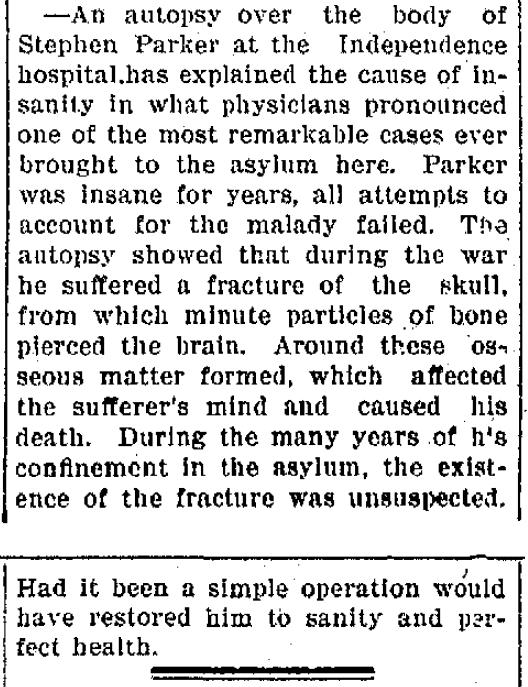
By 1895, he’s been committed to the Independence State Hospital for the Insane and is not longer living with the family. I haven’t been able to dig up anything that shows what his symptoms of insanity were. I thought perhaps alcoholism, but that doesn’t seem to fit with this news report filed shortly after his death, that appeared in the Waterloo (Iowa) Courier on 16 Jun 1897.

Report on Stephen Parker autopsy

An autopsy over the body of Stephen Parker at the Independence hospital has explained the cause of insanity in what physicians pronounced one of the most remarkable cases ever brought to the asylum here. Parker was insane for years, all attempts to account for the malady failed. The autopsy showed that during the war he suffered a fracture of the skull, from which minute particles of bone pierced the brain. Around these osseous matter formed, which affected the sufferer’s mind and caused his death. During the many years of his confinement in the asylum, the existence of the fracture was unsuspected. Had it been a simple operation would have restored him to sanity and perfect health.

So far this is the only madness I’ve found in my family tree, but there’s plenty more people to check out.

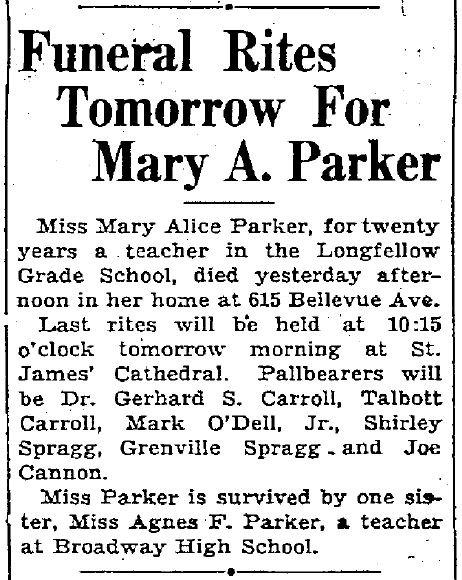
The Stephen Parker family story doesn’t quite end there though. Margaret Parker and her two daughters moved to Seattle in 1906 where they became employed by the Seattle School District. I love it when they live in Seattle, because I have so many more tools to find them. The Seattle Times used to list who was teaching where every year. Margaret died in 1924. Mary taught elementary, mostly at Longfellow School, which I believe was across the street from what’s now Miller Playfield. She died in 1932, at 615 Bellevue Ave. According to King County, it’s the same building there now.

Obituary for Mary Parker
Obituary for Mary Parker (Seattle Times, 11 Nov 1932)

Agnes taught high school mostly. She first taught at T.T. Minor. For several decades she taught at the Broadway School which used to be where the Broadway Performance Hall is now. But in the 1942 school year, she taught history at Ballard High School. Unfortunately, the paths between the Weiss side of my family and the Hathaway side did not cross; my grandfather graduate in the spring of 1942 and joined the merchant marine in May for the war.

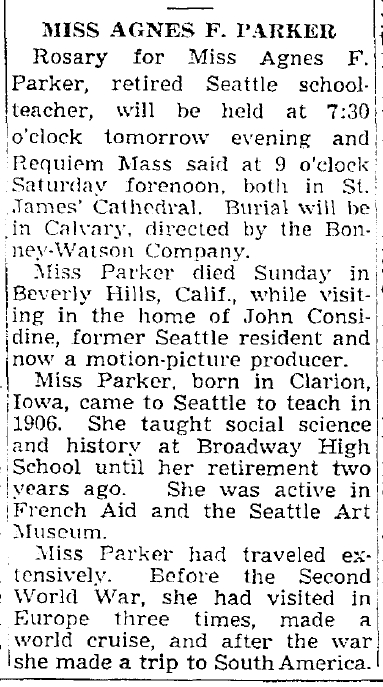
Agnes Parker retired in 1947. She was very involved as a supporter of the Seattle Art Museum throughout her time in Seattle. In addition to listing the teachers every year, the Time also listed who bought season passes for S.A.M. every year. And you think you give up privacy with Facebook! Agnes became friendly with the Considine family, local vaudeville and theater promoters until they moved to the burgeoning entertainment capital of the world, Los Angeles. It was on a visit to Hollywood producer John Considine Jr, that Agnes died.

Obituary for Agnes Parker
Obituary for Agnes Parker (Seattle Times, 12 Jan 1949)

Neither Mary nor Agnes had any children, so that branch of my family is not running around locally. I had hoped at first though, when I first found them in Seattle.

Agnes Troeller leads to Celia Weiss Klindt

I wrote about tracking down Clara Weiss, my second great aunt, in Upland California. I didn’t really know what had happened to her sister, Cecilia Celia. Turns out she was just down the road.

Finding a girl through the census records is hard, because they usually changed surnames when they got married. Celia shows up in 1860, 1870, and 1880. Then she disappears. She got married and doesn’t show up anywhere. Ancestry.com tells me the most likely entries are: Cecilia Garthwaite, Cecilia Lindsey, Cecilia McCready, etc. All of them born about 1858 in Wisconsin. Ancestry seems to rank them in terms of how close they are to Celia’s birthplace of Cassville, Wisconsin. In fact, Celia doesn’t show up at all in the first five pages of possibilities for censuses after 1900. I checked a lot of them, and most didn’t match up. Some could have been Celia, but I had no way to know via the census records.

So I kind of sat on that for a bit and pursued other Weisses. I got to Clara. She appeared only in 1900, and later I figured out why she wasn’t in 1910. Before I’d done that though, I started looking for her children. Her third child, Agnes Marie showed up in 1910, but not with Clara or Clara’s husband Conrad. She was part of the Henry J. and Anna C. Klindt household in Ontario, California. Her relationship to Henry was listed as niece.

1910 United States Federal Census Record for Henry J Klindt

Agnes is listed as the niece of Henry Klindt. So either Conrad Troeller is the brother of Henry or Anna, or Clara was the sister of Anna. There were no daughters of Anton Weiss listed as Anna in the 1860 through 1880 censuses. However, it was possible that Cecilia was a middle name. Among my grandparent’s family, George Archibald went by Arch, Florence Marie went by Marie, Richard Glenn went by Glenn and Laura Ann Francis goes by Francis. Perhaps that was common in their parent’s family as well, and Anna C. is Anna Cecilia.

Anna C.’s other stats matched up: born in Wisconsin around 1858, with both parents from Germany. Not enough to confirm it, but enough to start digging more. Luckily a few other things turned up. One other person had listed the wife of Henry Klindt as Anna C Weiss in their family tree. Still tenuous, but looking better. Around then I found Frank Smitha’s biography, and his page about his grandmother Clara.

My mother’s sister, Agnes, four years and three months older, was sent to live with Clarissa’s sister, Celia Klindt, whose husband, according to my mother, owned the main grocery store in Upland. Celia and husband were the family members on a path to wealth. They were putting their spare cash into buying property and in a few years, according to my mother, “Aunt Celia’s family owned flats as they called them, on Lake Street in Los Angeles. I think the property has been absorbed into McCarthur Park, as near as I can figure.”

The weight of the evidence was enough for me to put it in a confirmation column, even though some of the other facts on Smitha’s page are wrong.

The Klindt’s lived in South Dakota and Iowa for a bit, then went overseas to Germany for a couple of years. When they returned, they moved to Ontario. Henry’s passport application gave birth dates for his children as well as his intention to return in a couple of years. That’s awesome, because the census only gives approximate birth years and was generally transcribed as told to the census taker by the head of the house. The head of the house might not remember birth dates as well; the transcriber could mishear; the transcriber could miswrite it; the transcriber could have a bad sense of policies about first names vs. middle names. Some of them are really bad spellers.

I’m not sure the Klindts were wealthy, even though Smitha’s mother seemed to think they were. There were five children. Pauline, who married one Fred Jacobs. They moved back to Iowa where Fred died about 1916. Pauline moved back to California, and as best as I can tell never remarried or had more kids. Daughter Agnes married a George Bunker, then divorced him just a couple years later. She never appeared to remarry and the Bunkers had only one child George Jr. Daughter Mildred died about 1916 without marrying. Robert married Jessie Hermes around 1916, and by 1930 they had not had any children. The youngest child, Irving, married Edith Smith and they had a couple of daughters by 1930. None of the Klindts appeared to have lived in particularly wealthy neighborhoods, and I haven’t found any of them among the movers and shakers of southern California. But perhaps they were quietly wealthy. Who knows?

Neither Henry nor Celia lived to see 1930.

My thumb story

For those friends on Facebook, you already have the news. But as this is where I should be writing stuff for posterity, here’s the story.

Thursday night I decided to make sausage and beans, crock pot style. It’s a recipe I’ve done a lot, and I really like it. Basically, brown about 2 pounds of smoked sausage. Saute some shallots and garlic. Put it all in a crock pot with a couple cups of beans and chicken stock, and cook for four hours.

Where I went wrong was in chopping the shallots. Chop. Chop. Ow!

Took about an eighth of an inch of my thumb off. Basically the skin, some of the nail, and a little bit of the meat. It wasn’t quite as painful as I would have expected. At least as long as I didn’t touch the cut part that is. There was a lot of blood. I cut deep enough to sever some capillaries. Every time my heart beat, I could see a little gush of blood come out the thumb tip.

Called 911. Then realized I should just call a cab to get to the E.R. But once you’ve called, you’ve called. They called back, then sent the Fire Department down here. They bandaged me up. That was good, because I didn’t have anything to properly bandage something like this. Called a cab and went to the E.R. Turns out it wasn’t a deep enough cut to do anything with the little piece of thumb I’d removed. But the wound is too wide to stitch up. They cleaned it up, put a pressure bandage on to stop the bleeding, and gave me a tetanus shot.

Also, they gave me a couple of Vicodin for the pain. Turns out that Vicodin doesn’t seem to reduce my pain. It also doesn’t make me loopy or happy or anything like that. I do, however, get the nausea side effect. Not quite enough to upchuck, but enough to feel very queasy and want to hang out near the toilet. I decided not to fill the Vicodin prescription.

Other than pushing on the top of the dressing, I haven’t felt too much pain. The button fly on Levis has been a pain though. And I can’t left anything heavy because I can’t grip with both hands.

I changed the dressing tonight. I was supposed to change it after 48 hours, and then every 24 hours after that. Removing the dressing hurt big time. Felt like I was pulling off the skin, because it seemed to be glued onto the wound. Dunno if stuff had already started growing into the dressing, or if it was just congealed body fluids that wouldn’t soften in water. I’m not really looking forward to changing it again tomorrow. Hoping it isn’t as painful. Also, my new dressing is not as pretty as the one the nurse put on Thursday. If I had two hands free, I think I could have made it almost as good. But… well.

So there’s the story. I have pictures. I’ll get them on Flickr at some point, but I don’t plan on posting them here.

Geni

I know you’re thinking, why hasn’t Phil written about that genealogy stuff in two weeks? So I give you this to sate your desire.

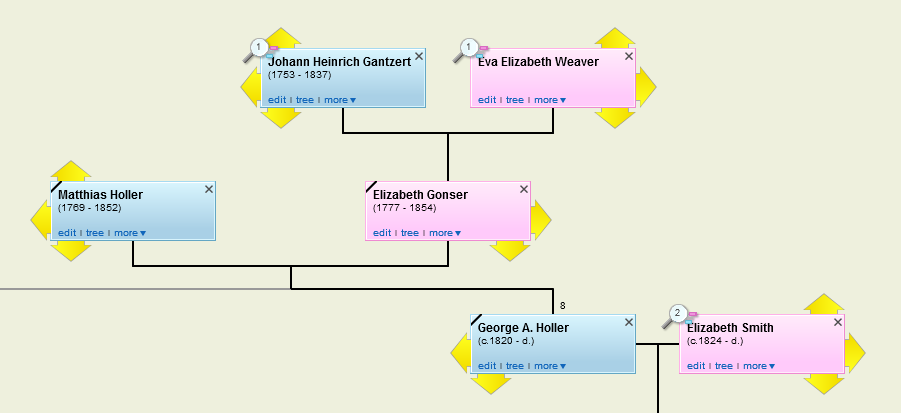
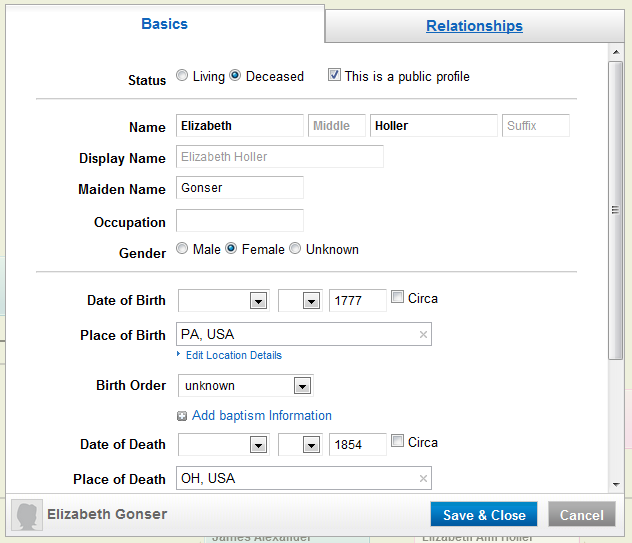
Last spring, when I first started poking around this, Sharon recommended I take a look at Geni. It has a nice and easy graphical user interface. Just click on add node, fill in a few details, and you can start building a family tree.

Geni Diagram
Basic Geni data entry dialog

I plugged in a bunch of people from Hathaways of America to get used to what it can and can’t do. It’s designed to be super easy to use.

What’s the major feature for Geni? Collaboration. Geni is constantly attempting to match the data I entered with thousands of other users. If a profile closely matches what someone else entered for one of their ancestors, Geni proposes a merge. If both users agree, the two users trees will share a profile for a single historical person, and their trees will be connected. Anything the other user enters affects my tree. The connected trees are no longer separate trees. They are one family tree.

I only had to enter the Hathaways up to my third great grandfather, Abner Hathaway. He’d already been entered by someone else, Geni proposed the merge, and now I share a family tree with the person who entered Abner.

This is very powerful. If someone else is able to document something for one of my ancestors, I don’t have to. I don’t even have to copy their information. It’s already there.

Geni has a number of these connected trees. Most of their users are connected to what they call The Big Tree. This has allowed me to find and chat with relatives that I didn’t know I had. The fellow who had also entered Abner Hathaway is Chad Bouldin. Abner is his wife’s fourth great uncle. I’ve found a 4th cousin in Sweden, and my grandfather’s cousin.

Geni has a fair number of celebrity profile entered. Because Geni has a big tree, I can tell you how I am related to a number of them. One of the Hathaway wives was descended from English royalty, so there’s a lot of documented connections. Through that, I can tell you that I am Eminem’s 22nd cousin, twice removed. That’s if people have the connections correct.

Which brings me to the first of a large number of problems with Geni, and ultimately why I don’t use it except to find these connections. The first is that there’s lots of bad and speculative information there. If I want to draw up my own family tree based on a family legend that grandpa Patrick (not my real grandfather) was Elvis’ illegitimate brother, I can do that. When you do it on Geni, everyone is now affected. And there are lots of people who insist on putting in very bad and incorrect information. Kings who were the sons of giants in mythology, for instance. I am not the 44th great grandson (it says 50th great grandson now) of Jesus Christ. But since a gnostic gospel says Christ fathered so-and-so, and there’s a large contingent of biblical and mythological literalists on Geni, there’s no changing it.

The second big problem is with data entry. There’s lots of events in a person’s life that genealogists care about and want to record. My great grandfather Johan Oman came to the U.S. in 1909. There’s no good way to record immigration in Geni. Birth, death, baptism, marriage and burial (and their locations) are the pieces of data that Geni records well. As for relationships, it records parent-child and husband-wife relationships. Geni cannot record adoptions.

A third major fail is with recording sources. Ancestry.com is the king of handling sources for genealogy. Geni lets a user upload documents and associate which facts are documented in each. But the user interface is clunky and weird and it’s difficult to share sources.

The fourth major lack is with data portability. I can only import data the first time I sign up. Afterward, it has to be entered manually. The export options are awful. Export of data is fairly complete. But Geni limits the set of profiles I can export. I can do ancestors, descendants, blood relatives, and forest. There’s no option to export data for all people I’ve entered. If I enter the wife of a second cousin, that person is not a blood relative, ancestor, descendant or even a blood relative. I can’t export it easily. The forest option allows this, but that exports everyone I’m connected to, and that’s a 50 Mb file containing 100,000 people that is too large for most genealogy programs. And you have to pay for that export too.

I realized most of this in June, but I’d already entered a fair amount of information. I was locked in to some degree. But problems #2 and #4 got to be annoying enough that in August I decided I would make something else my primary genealogy data storage. Geni is still useful for connecting up with other trees. Very very useful. But not a good base to store everything I want to know.

2011 Goals – Week 2

A little late getting this posted this week. This reflects the status as of Sunday night.

Grandparents’ estate: Got word from the state that they are denying the death benefit claim. Need to decide whether to appeal. Will ping lawyers and CPA this week on status of things in their hands.

Mom’s estate: Nothing happened that I know of. Dad reports he has mail from Vanguard. Will head up there this week to see if any of it is related.

Gym: Fail.

Cooking: Cooked 4 meals at home this week, not including the pies for Pie Night.

Swedish: About 1 hour spent on Swedish, mostly on pronunciation. Game theory: Fail.

Dating: Asked out two women this week. No dates.

Travel: Not yet booked.

House: Cleaned up for 15 minutes 6 of 7 nights this week. Productivity: Was productive 4 mornings shortly after 9 a.m. One day fail.

Book blog: Did nothing this week. Fail.

Eulogy for Gramps

I meant to post the eulogy I said at Gramps’ funeral last year, but didn’t get around to it. Posting now as a method of archiving it so I can toss the paper copy. I kept it short because I knew I was going to be unable to hold in the waterworks. As it was, this still took me nearly 5 minutes to say.


My hero died on Wednesday. Since I was little, Gramps has been the man I want to be. Many people are known because the do something very well. In Gramps’ case, he was a firefighter. I once watched him run to a burning cabin from the Ponderosa community club. That was great, knowing he saw that danger and knew what to do. But I didn’t want to be a firefighter; I wanted to be like Gramps.

I want to be loving and open. Gramps and Gram were married over 60 years, and their marriage was still as strong last week as it was 30 years ago when I was a kid. I want to be able to call my wife lover-girl, in front of anyone. He didn’t hide anything. Like him, I want the self-confidence to tell people what’s important about me. He was generous and without judgment. He patiently taught me how to drive a standard shift, while I killed the engine of his car over and over. Never once did he tear me down. When a student I was mentoring started applying for scholarships, Gramps gladly spent an afternoon going over scholarship applications with her so she would be ready. He gave his time because I asked and because she needed it. Nothing more. I could list his good qualities for some time.

Now he’s gone. I miss him already. We all do. That’s why we are here. But what I’ll miss most is the living example of who a man can be. I’m proud to say I’m his grandson. I hope that people who knew him will tell others, That’s Cleo Hathaway’s grandson, not because of blood-line, but because I’ve learned well from him. Because I still want to be like my hero.

Clara Weiss Troeller

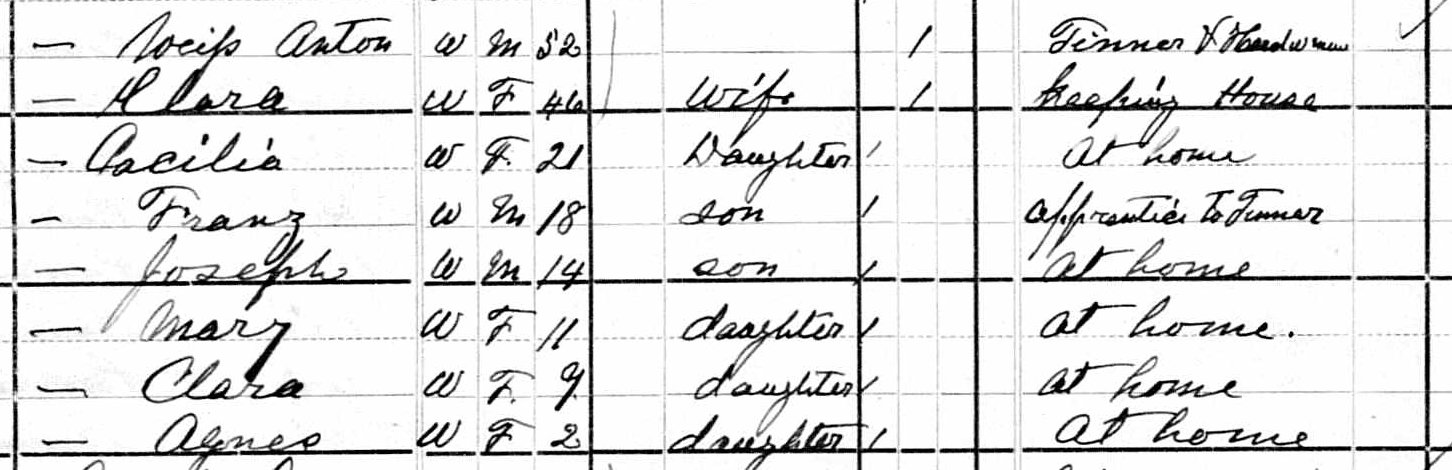
Figuring out that Anton Weiss is my great great grandfather opened up a lot more of the family tree quickly. The 1880 Census lists a number of children of Anton and Clara Weiss, and that’s where I started from:

1880 United States Federal Census Record for Anton Weiss family

Then I checked the 1860 and 1870 census records and also found Anton and Clara Weiss:

1860 United States Federal Census Record for Anton Weiss
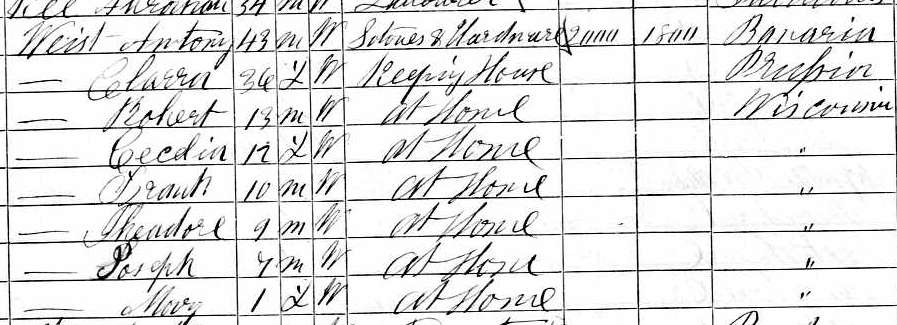
1870 United States Federal Census for Anton Weiss

The listed children in 1880 were: Cecilia (~1859), Franz (~1862), Joseph (~1866), Mary (~1869), Clara (~1871), and Agnes (~1878).

The listed children in 1860 were: Robert (~1857) and Celia (~1858). I’d previously found the 1860 record, but didn’t do anything with it because I didn’t know if Anton Weiss was the correct father for Joseph. Celia is certainly Cecilia. Over the course of the decades, the U.S. Census has been taken on different dates: 1 Jan, 1 Apr, 15 Apr, and 1 Jun (at least). But both the 1860 and 1870 censuses were taken officially as of 1 Jun, so the difference in approximate birth dates is just someone getting it wrong, either the census taker, or whoever in the Weiss household the worker talked with.

The 1870 census record was harder to find. In the 1870 Census, the two are listed as Antony and Clarra Weist. All of these census records are found on Ancestry.com, where people have transcribed and indexed them. The Ancestry.com name matching algorithm is pretty good, but for some reason it never matched Anton Weiss with Antony Weist. Wise and Weise match, but the t messed up the soundex type search. At this point, I don’t remember what I put in that finally pulled up the name, or if I went through the Cassville records page by page. For a small place like Cassville, reading every page is fairly easy. There are 23 pages for Cassville in 1860, and 34 in 1870. Reading page by page would be much more laborious for a place like Los Angeles.

The children listed in 1870 were: Robert (~1857), Cecelia (~1858), Frank (~1860), Theadore (~1861), Joseph (~1863) and Mary (~1869).

Here, the birth years for Joseph and Frank really don’t match up, and Theodore’s doesn’t match with other information I have either.

It’s usually easiest to track the male children, because they don’t change their names when they get married, like women overwhelmingly did. However, I had a really good clue for Clara Weiss, so I started tracking her first.

1900 United States Federal Census Record for Anton Weiss

In the clip of the 1900 Federal Census record for Anton Weiss, I included the house and family number column. Some of the censuses include the street address, but this is a different number. Each census taker basically counted off families and dwellings. Sometimes several families would live in the same house. Anton and Clara had the 44th house counted in Cassville, and were the 45th family. Everyone in the same family number is related. Related being in quotes because sometimes servants were counted as their own family, and sometimes not. The last person listed is a Loueller, Clara, listed as a daughter born in March 1871. So it looks like Clara married someone named Loueller!

There’s possibly an interesting story behind that. Why was Clara at her parent’s house in 1900? Was she just visiting? Were she and her husband estranged for a period? Was she stashed at her parents’ for expediency while the husband was setting up a new household or conducting business? I still don’t know.

Searching for women named Weiss who got married in Wisconsin at the Wisconsin Genealogy Index brought up 2 promising hits: Clara Weiss married in Grant County in May 1896, and Clarissa S. Weiss married in April 1894 in Monroe County. I checked Grant County first, because that’s where Cassville is. That Clara Weiss looks to have married a Richard Gross. I’m not 100% certain of that because I haven’t purchased the original record, but his is the only male name that came up as getting married on the same day. It would have to be a pretty weird set of circumstances to marry someone in 1893, marry someone else in 1896, and carry the first person’s surname again in 1900. Clarissa Weiss getting married 4 Apr 1894 seemed like a better possibility, but the possibly spouse search turned up no hits.

Then I looked at the 1900 Census image again, and thought perhaps the name was not transcribed correctly. That could possibly be a Tr and not an L. Plugging in Clara Troeller brought up all sorts of hits, including another one for 1900 in Larrabee, Iowa married to a Conrad Troeller! Thank god for double counting. As it is, a number of people in the Troeller family had already entered her into their family trees, some with the Weiss last name. None of them had connected her to Anton Weiss, but it was enough for me to match them.

Going back to the Wisconsin Genealogy Index, Conrad Troeller does indeed appear, and married someone on 4 Apr 1894. But his marriage is listed in Grant County rather than Monroe County, which confused the possible spouse search. I haven’t yet ordered the original record for that, but I assume it’s an indexing error.

Other states they’ve lived in kept better records and more of them are public, so I as able to find a lot. Helpfully, someone in San Bernardino County, California cataloged a lot of head stones and put the list online, and one of them had her name. Upland California seemed like a long way away, but the other information matched.

So here’s the story as best as I can piece it together from the genealogy records: Clarissa Sophia Weiss was born on 4 Mar 1871 in Cassville, Wisconsin. She married Conrad Troeller from Dodge County, Wisconsin on 4 April 1894 in Cassville, Wisconsin. The Troellers moved to Brule County, South Dakota either with or shortly after her brother Frank (more on him later), where she had a son Harold in 1896. By 1898, Conrad and Clara had moved to Larrabee, Iowa where Conrad worked as a hardware dealer and they had son Paul in 1898 and daughter Agnes in 1903. By 1907, they’d moved to the Los Angeles area, where daughter Margaret was born in that year. But Clara is not to be found in the 1910 census; she died a couple of months before the census on 24 Feb 1910.

What happened after she died explained why they moved to California in the first place, and provided me with a clue as to where other members of my family were. And I have more sources than I did last month too. But that will have to wait for another entry.

2011 Goals – Week 1

I have the internet, and I’m not afraid to write stuff on it that you don’t care about!

Grandparents’ estate: Received and cashed a check from the last insurance policy for my grandparents. Notified the CPA of the same payment. Submitted a claim to the state for a death benefit for my grandfather. Waiting for CPA to do tax return.

Mom’s estate: Got confirmation that her IRA was moved into a new account at Vanguard. Confirmed with Vanguard that they have the transfer paperwork to move it to RBC. Waiting for transfer to happen. Waiting for RBC new account confirmations. Following that, paying lawyers and CPAs, filing with probate.

Gym: Fail.

Cooking: Cooked twice this week successfully. Attempted a third time but botched the meal. Should start tracking how many times I eat out.

Swedish: About 3 hours spent on Swedish, mostly on pronunciation. Understand the basics of Swedish pronunciation, but not the multitudes of special cases. Game theory: Fail.

Dating: Did not ask anyone out this week.

Travel: Not yet booked.

House: Cleaned up for 15 minutes 5 of 7 nights this week. Productivity: Was productive 4 mornings by 10 a.m., and most mornings shortly after 9 a.m. Friday was not productive at all.

Book blog: Installed theme and contact form for one piece of transfer. Need to do formatting and enter data.