Vaughn Walker’s Proposition 8 decision

By now, most of my friends know that a judge in struck down California’s Proposition 8. Being the obsessive person that I am, I downloaded a copy of Vaughn Walker’s decision on Proposition 8. Here’s a couple of thoughts I have on it. Keep in mind that I am not a lawyer, so my speculation is probably suspect.

First, he laid out a lot of facts in the record to support his conclusions. And his legal reasoning based on those facts is detailed and methodical. The analyses I’ve seen online say that going to make it harder to overturn.

However, the Proposition 8 proponents were fairly negligent in putting on their case. They called two experts who were not qualified. I wonder how much precedential weight other courts will give the case when people challenge similar laws in other states because of this. Will they allow bigots in other states to put on a better case or will they give weight to the essentially unopposed facts and conclusions from this decision? If this were a death penalty case, the proponents would have a great case for ineffective assistance of counsel. I personally believe the scientific evidence offered in the case by marriage equality folks is pretty unassailable, but their opponents barely tried.

One of the facts that was a pretty important part of this case was the fact that California does not discriminate based on sexual orientation in adoption and child fostering. With or without Proposition 8, California viewed gay parents as equal to straight parents. That was one of a couple of facts underlying his decision that are specific to California.

That’s important because it totally undercut one of the reasons the Prop 8 proponents gave as a compelling government interest in banning gay marriage. They claimed the state had a compelling government interest to ensure that that children are raised by biological parents of opposite sexes. Since Prop 8 did nothing to change how gay parents would be treated, that could not be a compelling government interest behind Prop 8.

So, that makes me wonder if states that have been more intransigent in their deleterious treatment of homosexuals might have an easier time getting their gay marriage bans upheld. In other words, the might get away with claiming a compelling government interest in ensuring children have biological parents raising them.

Then again, an appeals court might give a fairly broad-based reason for upholding the decision that makes that reasoning moot.

The facts not specific to California could carry over to other cases unless other folks are allowed to put on a case that challenges the established facts in this case. I’m not really sure if other courts would just assume these facts are uncontroverted, or what. Things like studies that show no difference in child outcomes for gay parents versus straight parents when other family status items like class or cohabitation status are controlled for. Or that studies of gays and lesbians as a group show they do not have political power (used to support the designation of sexual orientation as a suspect class and justify strict scrutiny). At what point in the life of this issue as a legal controversy do those become dicta?

Anyhow, it’s a really good decision. Much better than the Washington State Supreme Court decision on gay marriage a couple of years ago. And I say that not because I like Walker’s conclusion better (though I do), but because it’s much more thoroughly reasoned.


My Genealogy

One of the things I’ve been doing over the last few months is assembling my genealogy. Unfortunately, I was spurred to do this because my grandparents died. I *should* have done this last year when I could have asked them some questions. I’ve got the big book of Hathaways. My grandmother had some cobbled together information on the Swedes. My aunts on my father’s side assembled some information on the Weisses, Solle’s and Sorenson’s but not a lot. (There’s also a decent amount of information put together about my step-father’s family.)

I’ve been piecing all this together. I’ve also been digging through census records and other stuff available online. In addition, I’ve been able to match up people in my family tree with family trees other people have put online. Whenever I’ve been able to add to the tree through my own digging, I get a little thrill.

I’ve two great grandparents who emigrated from Sweden early last century. I’ve got pretty extensive records for the Swedish family. Also on the maternal side of the family are the Hathaways, who came to the U.S. way back. There are lots of other families that married into the Hathaways along the way, so that branch of the family is essentially mutt. The original Hathaway immigrants were English, but we’re talking three or four centuries ago. The records for the Hathaways are extensive too.

On my father’s side of the family, there are the Weisses from Wisconsin. My great grandfather Joseph Weiss’ parents emigrated from Germany. His wife was a Ryan, born in Wisconsin to an American and a Canadian. My other great grandfather on my father’s side was William Solle Jr., son of German immigrants, though they married in the U.S. and I presume they met here too. His wife was Flora Sorenson, daughter of Danish immigrants. Until a couple of years ago, I thought this whole side of my family was German.

By my addition, that makes me one quarter Swedish, one quarter German, one eighth Danish, one sixteenth Canadian, and five sixteenths a mixture that includes some English. Of course, the Canadian blood probably isn’t First Nations, but I don’t know who comprises that part of the family yet.

Anyhow, except for the Hathaways and possibly the Ryans, all my family are pretty recent immigrants.

I entered in the known information for my step-father too, even though they aren’t blood relatives for me. I knew his family was German. But what I didn’t know was that they didn’t immigrate from Germany. Both sides of that family were Germans who emigrated from Russia in the early 1800s and colonized Russia, in a part that’s now in the Ukraine. They left Germany due to Napoleon. A generation or two later, some of them left there and emigrated to the U.S. settling in North Dakota. Had no idea the Germans had colonized Russia. From what I gather, it was at the invitation of the czar.

The Tunnel

Something political for you:

Yesterday, The Stranger published an in-depth piece about the things that could go wrong with the proposed deep-bore tunnel downtown that would replace the Alaskan Way Viaduct. The Stranger’s reporting has gone downhill since Josh Feit left a few years ago, but this one is pretty good muck-raking yellow journalism. I urge you to read it if you live around here.

I’m not particularly invested with whether we replace the viaduct with a tunnel, another viaduct, or with a surface option. I don’t think having unshadowed access to the downtown waterfront is key to Seattle’s future. I wouldn’t mind it, but whatever. I do care about a couple of things though. First, the current viaduct is unsafe and should come down.

Second, I don’t think it should be Seattle’s responsibility to pay for the replacement. And that’s where things seems to have gone off the rails in the last year. As it stands right now, if anything big goes wrong with the tunnel construction (and if you read The Stranger article, much could), there’s no money to pay for fixing the problems. The state has said it will try to find a way to make Seattle residents pay for it, on the theory that we’re the ones who really want the tunnel. The Seattle City Council (or at least a couple of them, Tim Burgess and Richard Conlin) say we won’t have to pay, but all they offer is some trust us, we’ll make sure we don’t have to pay statements. In the meantime, the City Council wants to move ahead and sign contracts without dealing with the issue of what to do with cost overruns up front.

So what? Stuff’s gotta be paid for right? I’m generally in favor of levies and taxes for needed things. However, Seattle already has a huge deficit, according to the 2010 Seattle adopted budget. We have revenue of $3.4 billion ($1.2 billion from property taxes) and expenses of $3.8 billion. We’re already trying to figure out how to make up that $400 million. A lot is coming from other resources. Cost overruns on the tunnel could easily double our deficit. In other words, if something goes wrong big time (and that often happens), we’re either going to see significant property tax increases, or we end up with an unfinished and useless tunnel, no viaduct, and the state has spent a buttload of money that we don’t get back. The third option is to spread the cost increases across the state, but that’s not the way the law reads right now.

If you live in Seattle, it behooves you to let the City Council know now that you’d prefer cost overruns be planned for now. Richard Conlin and Tim Burgess are probably the two council people who need opposing feedback the most. Or, if you’d prefer to cross your fingers, you can just not do anything.

Sunset West

We listed my grandparents’ condo today. They lived there for 36 years. I couldn’t afford to buy it, but I’m not particularly sad about that. I am really sad my grandmother didn’t get to see the photos in the listing though. They intended to sell the place, but with them in the hospital I refused to spend a lot of time and effort cleaning the place and prepping it for sale when I could be spending time with them. It just wasn’t my top priority. It would have happened, but slowly. My grandfather understood. After Gram came back from the hospital, her memory wasn’t very good. She remembered they were going to sell it and that stagers were going to prepare it. But she couldn’t remember when I told her it wasn’t ready yet. She kept asking to take a trip to see what it looked like staged. She wasn’t in any shape to do so, besides the fact that it wasn’t staged yet.

As you can see from the photos in the listing, the place looks gorgeous. Not really much like when they lived there though. It had the cluttered grandparents look. The look the stager was going for was successful mid-40s manager.

I’m going to miss it.

My mom’s voice

I haven’t heard my mom’s voice since just after Christmas 2006. She slurred her words starting in January and used a Dynavox starting in July. Those sounds have replaced my memories of her voice. I couldn’t remember it.

Called Dad’s cell today and got his voicemail for the first time ever.

It’s mom on the message.

I’ve got her voice back.

But I can’t hold myself together.

Attempting to switch to Google Chrome

Firefox has been my browser of choice for a number of years, and before that I used the Mozilla all in one browser. Before that, Netscape and Mosaic. I’ve stuck with this line for quite some time. Tried out Safari, tried out Opera. Tried out a few others too. Firefox was fast and extendable.

I’ve liked Chrome for a while, but the ad blocking extensions in it weren’t up to snuff compared to Firefox. But in the core browsing functions, it kicked ass. I’ve used it for many of my web apps (GMail, Calendar, Remember the Milk, etc.) for a while. Fast. Best support for standards. Those pesky ads though.

The reason the ad blocking wasn’t so good was that extensions didn’t have good access to other web pages. Chrome’s enabled that now that it can allow extensions to request permissions.

I’m going to attempt to make Chrome my default browser now. See if there’s anything about Firefox that makes me want to go back. So far, all I seem to miss is some functionality from the GMail Manager extension that lets me switch between Google accounts quickly.

ETA: I know I’m going to miss Firebug. But I use that only when I’m working on my site, and in a couple of small situations.

Women in S.F. Meme

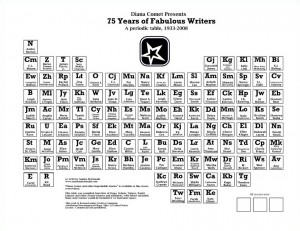
List based off the original Women in S.F. periodic table. In some of the incarnations of this meme, the list of women has morphed. Not that adding women to the list is a bad thing, but it makes it hard to compare.

I own books by the author if they are bolded. If italicized, I’ve read them (including short stories). If marked with an asterisk, I’ve not heard of the author.

  • Johanna Sinisalo *
  • Andre Norton
  • C. L. Moore
  • Evangeline Walton *
  • Leigh Brackett *
  • Judith Merril
  • Joanna Russ
  • Margaret St. Clair *
  • Katherine MacLean *
  • Carol Emshwiller
  • Marion Zimmer Bradley
  • Zenna Henderson *
  • Madeline L’Engle
  • Angela Carter *
  • Ursula LeGuin
  • Anne McCaffrey
  • Diana Wynne Jones
  • Kit Reed
  • James Tiptree, Jr.
  • Rachel Pollack *
  • Jane Yolen
  • Marta Randall *
  • Eleanor Arnason
  • Ellen Asher *
  • Patricia A. McKillip
  • Suzy McKee Charnas
  • Lisa Tuttle
  • Nina Kiriki Hoffman
  • Tanith Lee
  • Pamela Sargent
  • Jayge Carr *
  • Vonda McIntyre
  • Octavia E. Butler
  • Kate Wilhelm
  • Chelsea Quinn Yarbro
  • Sheila Finch *
  • Mary Gentle *
  • Jessica Amanda Salmonson *
  • C. J. Cherryh
  • Joan D. Vinge
  • Teresa Nielsen Hayden
  • Ellen Kushner
  • Ellen Datlow
  • Nancy Kress
  • Pat Murphy
  • Lisa Goldstein
  • Elizabeth Ann Scarborough
  • Mary Turzillo *
  • Connie Willis
  • Barbara Hambly
  • Nancy Holder *
  • Sheri S. Tepper
  • Melissa Scott
  • Margaret Atwood
  • Lois McMaster Bujold
  • Jeanne Cavelos *
  • Karen Joy Fowler
  • Leigh Kennedy *
  • Judith Moffett
  • Rebecca Ore
  • Emma Bull
  • Pat Cadigan
  • Kathryn Cramer
  • Laura Mixon *
Periodic Table of Women in S.F.

  • Eileen Gunn
  • Elizabeth Hand
  • Kij Johnson
  • Delia Sherman
  • Elizabeth Moon
  • Michaela Roessner *
  • Terri Windling
  • Sharon Lee *
  • Sherwood Smith *
  • Katherine Kurtz
  • Margo Lanagan
  • Laura Resnick
  • Kristine Kathryn Rusch
  • Sheila Williams
  • Farah Mendlesohn
  • Gwyneth Jones
  • Ardath Mayhar *
  • Esther Friesner
  • Debra Doyle *
  • Nicola Griffith
  • Amy Thomson *
  • Martha Wells *
  • Catherine Asaro
  • Kate Elliott
  • Kathleen Ann Goonan *
  • Shawna McCarthy *
  • Caitlin R. Kiernan
  • Maureen McHugh
  • Cheryl Morgan
  • Nisi Shawl
  • Mary Doria Russell
  • Kage Baker
  • Kelly Link
  • Nancy Springer *
  • J. K. Rowling
  • Nalo Hopkinson
  • Ellen Klages
  • Tananarive Due
  • M. Rickert
  • Theodora Goss
  • Mary Anne Mohanraj
  • S. L. Viehl
  • Jo Walton
  • Kristine Smith *
  • Deborah Layne *
  • Cherie Priest
  • Wen Spencer *
  • K. J. Bishop
  • Catherynne M. Valente
  • Elizabeth Bear
  • Ekaterina Sedia
  • Naomi Novik
  • Mary Robinette Kowal
  • Ann VanderMeer
 

Summer Pie Night

strawberry pie

It’s a bit shorter notice than previous incarnations, but here’s the official announcement/invite to the next Pie Night! It will be Friday, June 18th, running officially from 3 p.m. until whenever. Show up any time before the pie is consumed. Location will be my place; the pool if it’s sunny, inside if not. Take off from work early and enjoy a bit of sun and tasty pastries. Please state if you are planning to come and if you are bringing a pie in comments.

What is Pie Night? Do you need to ask? It’s all about pie! I make pie. Other people make pie. People eat pie. You do not have to bring pie. You have to eat pie if you come.

Really, that’s all there is to it.

My address: 2301 Fairview Ave E, Seattle.

Oh, and to answer the inevitable question: no I do not know what pies I will make. I never decide until a day or two before.

Photo by Heather Katsoulis, used under a Creative Commons Attribution ShareAlike license.

The web according to Phil 4-14-2010

Two from Bruce Schneier

Privacy and Control — To the older generation, privacy is about secrecy. And, as the Supreme Court said, once something is no longer secret, it’s no longer private. But that’s not how privacy works, and it’s not how the younger generation thinks about it. Privacy is about control.

New York and the Moscow Subway Bombing — [Movie plot threats] threats are infinite, and the bad guys can easily switch among them. … A far better strategy is to spend our limited counterterrorism resources on investigation and intelligence – and on emergency response. These measures don’t hinge on any specific threat; they don’t require us to guess the tactic or target correctly. They’re effective in a variety of circumstances, even nonterrorist ones.

A few on Virginia’s Confederate History Month declaration

McDonnell’s Confederate History Month proclamation irks civil rights leaders — After getting criticized for a Confederate History Month declaration that didn’t include a mention of slavery, McDonnell says he didn’t include it because there were any number of aspects to that conflict between the states. Obviously, it involved slavery. It involved other issues. But I focused on the ones I thought were most significant for Virginia.

Spelling “Free Black Labor” in Greater Britain and Virginia, 1866 — for reasons of my own, let me take you back to a particular corner of it that I’ve gotten interested in, white reconstruction as a model for the British Empire. Aaron Bady digs up excerpts from books about Reconstruction, published during Reconstruction.

Sons Of Confederate Vets Split On McDonnell Apology — Brandon Dorsey of the Sons of Confederate Veterans (his actual position isn’t stated) calls the apology and addition of slavery to the proclamation regarding Virginia Confederate History Month and insult.


The Unpaid Intern, Legal or Not — The interns hired into our department at Expedia actually got to take on significant projects. We didn’t have them do drudgery so that we didn’t have to. Every time I see a place advertise for an unpaid intern that will be given all the crap work in exchange for contacts or the mere ability to list the employer on their resume, I seethe. The Stranger does the a lot.

Federal Air Marshal Service Has Taken Actions to Fulfill Its Core Mission and Address Workforce Issues, but Additional Actions Are Needed to Improve Workforce Survey — G.A.O. report from last year on the Federal Air Marshal program. Mostly boring stuff about employee satisfaction, but one thing that I noticed is that the program measures it’s success essentially by number of flights it sends marshals on. Not on whether or not it’s prevented any problems, not on arrests, not on anything else. Basically, how many flights were covered. Which is kind of like measuring the Seattle Police Department’s success by how many miles their officers cover. It’s bad if they are on no flights, but more flights doesn’t necessarily mean success.

I randomized the law, and the law won — Actual randomized experiments in policing to see what’s most effective. I wish we could do this a lot more, both in criminal justice as well as all sorts of other industries.

Demolition Dude — My time-waster today.

The Web according to Phil (4/2/2010)

Stuff I read read about today:

Seattle’s first technical book store coming soon to Capitol Hill
The bookstore is named for Ada Lovelace, a 19th Century pioneer in computer programming. She is celebrated today as a symbol of all the great women who add to the advancement of technology. a) Really happy we’re getting a tech book store. b) Really happy to see it named after Ada Lovelace. Women are way under-represented behind the scenes of tech, and a lot of that is because of attitudes that drive them away. Not that this will change a whole lot, but now everyone who goes to Ada’s Technical Books will hopefully have their curiosity piqued and know a bit more about women in tech because of the name.
Where are the Women?
NPR’s Ombudsman looks at gender balance in on-air staff, paid commenters, and interviewees, and finds the balance severely lacking in the latter two categories.
alikewise
Alikewise is a dating site that allows you to find people based on their book tastes. Anything from cooking to politics to yoga — we think we can find others who would like to talk to you. No, not on the market. But I totally would’ve used this a couple years ago. If nothing else, I know that the people using the site are actually readers! Very important to me.