Alex King is the creator of the Share Icon. I can’t say whether he still owns the copyright or not, but the the thing about Creative Commons licenses is that they are irrevocable. ShareThis Inc., or whatever their legal name is, cannot revoke the license.
So long as I give credit to Alex King (which I just did) and link to the license (which I just did), I can use this image however I want, per the terms of the license:
You are free to:
Share — copy and redistribute the material in any medium or format
Adapt — remix, transform, and build upon the material for any purpose, even commercially.
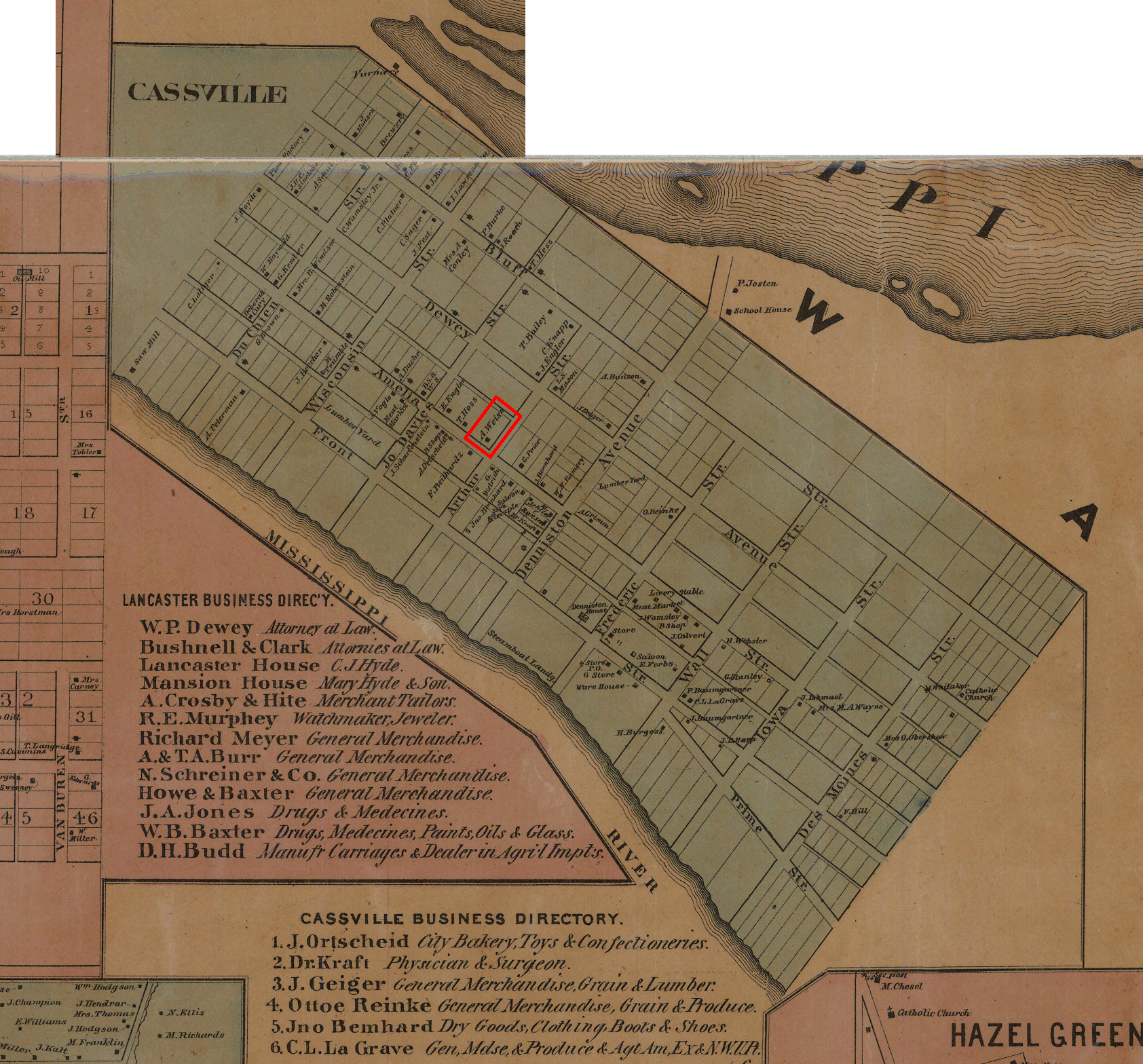
There was another item in the map I found yesterday that is of interest to me. On one of the other sheets is a city map of Cassville, where my great great grandfather Anton Weiss operated a hardware store for close to 50 years.
Just as I was able to find Patrick Parker in Glen Haven, Anton Weiss store shows up in this map too:
Map of Cassville in 1868 showing Anton Weiss
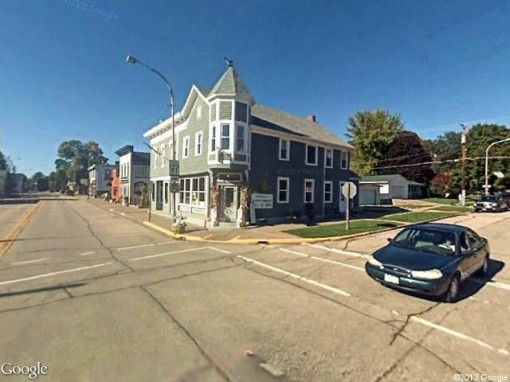
Here’s what the location looks like today:
Denniston and Amelia, Cassville in 2013 (Google Street View)
I’ve made one visit to Cassville, but at the time I didn’t know the location of the family home.
My genealogy white whale since shortly after I started has been finding Patrick Parker and his wife Mary Murphy. I’ve written about them here multiple times. I’d found pretty solid evidence on what happened to 8 of their 10 children, the only two where I was missing basic information were the sons James and John. Last month I found good evidence for James. Two weeks ago I found John, though I haven’t pursued it much yet.
But as much information as I’ve found on all their children, the evidence I have for the pair themselves is aggravatingly small. I’ve located them together in the 1851 Canada Census, the 1860 US Census, and the 1870 US Census. I have a possible grave site for Patrick in Iowa. And Mary Murphy can be found in the 1885 Iowa Census. That’s the sum total of direct evidence I have for them.
I have indirect evidence for them. I know they arrived in Canada between 1832 and 1835, based on the listed countries of birth for their children. The death records for several children list their names. The grave marker for my great great grandmother Mary Parker Ryan gives a place of birth for her, which places Mary Murphy in that place at least.
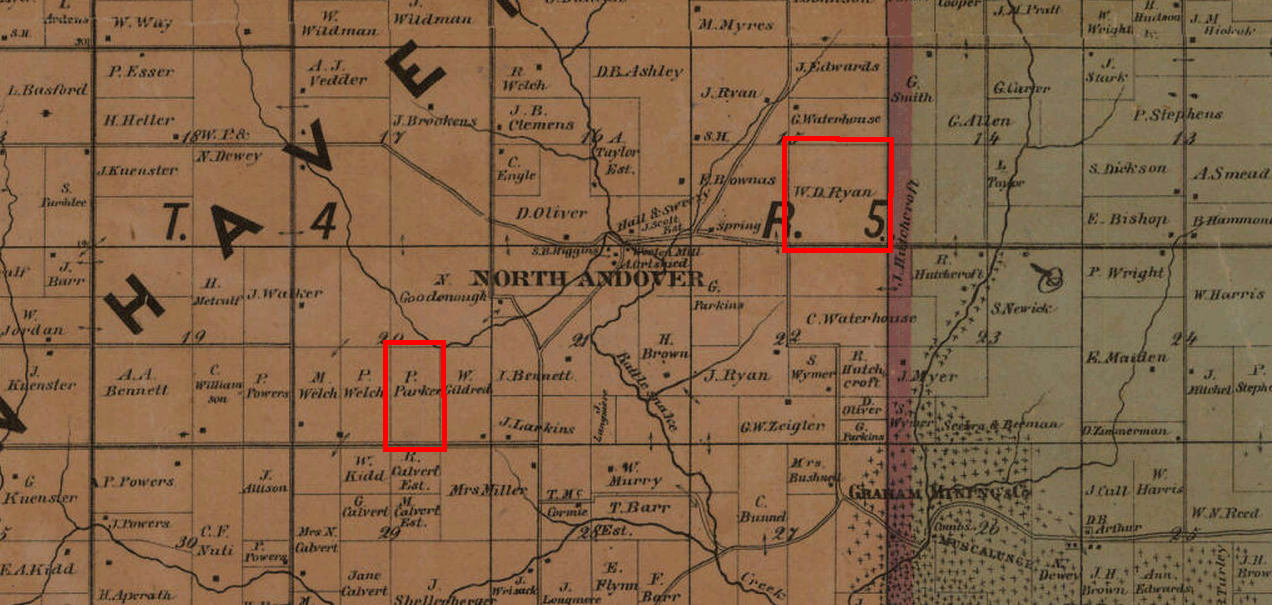
Today I was looking through the online maps collection for the Wisconsin Historical Society, and I saw they had added a map for Grant County from 1868, and the description included “shows townships and sections, landownership, …” The earliest landownership map for Grant County that I’ve viewed came from 1878 and the Parkers were not to be found on it. So, I took a peek at the 1868 map:
1868 map of Grant County, Wisconsin showing the Parker and Ryan farms highlighed
Lo and behold, there he is! The P. Parker farm is just southwest of North Andover (a town which is no longer a town). On the map, I also highlighted the location of the farm for Patrick Parker’s son in law, William Dennis Ryan. And with handy Google Maps, I can show you where the Parker farm is on today’s maps.
This is the first direct piece of evidence for their existence that I’ve found in nearly 2 years. You don’t know how thrilled I am about this.
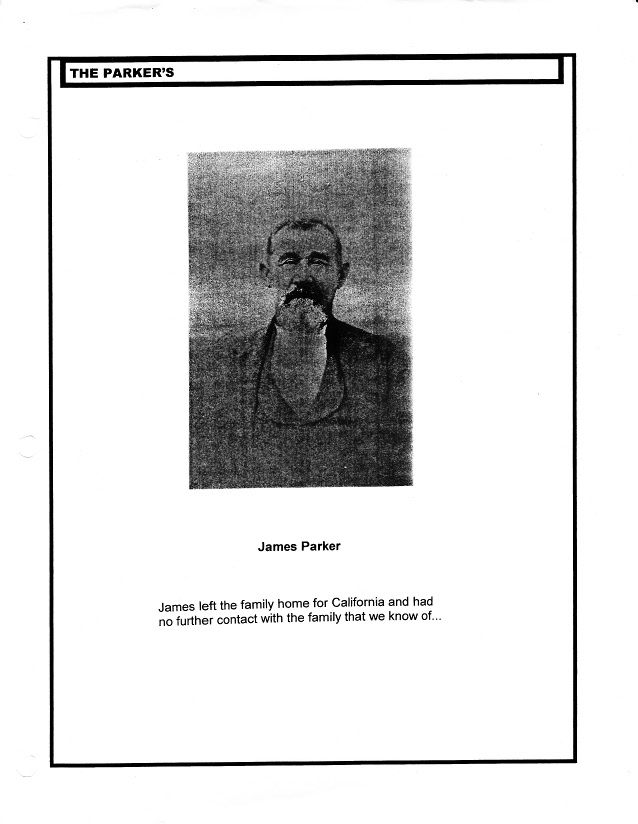
I’ve previously written about Patrick Parker and his wife Mary Murphy. One of the family legends passed on to me by other researchers was that they had a son names James who went off to California, never to be heard from again.
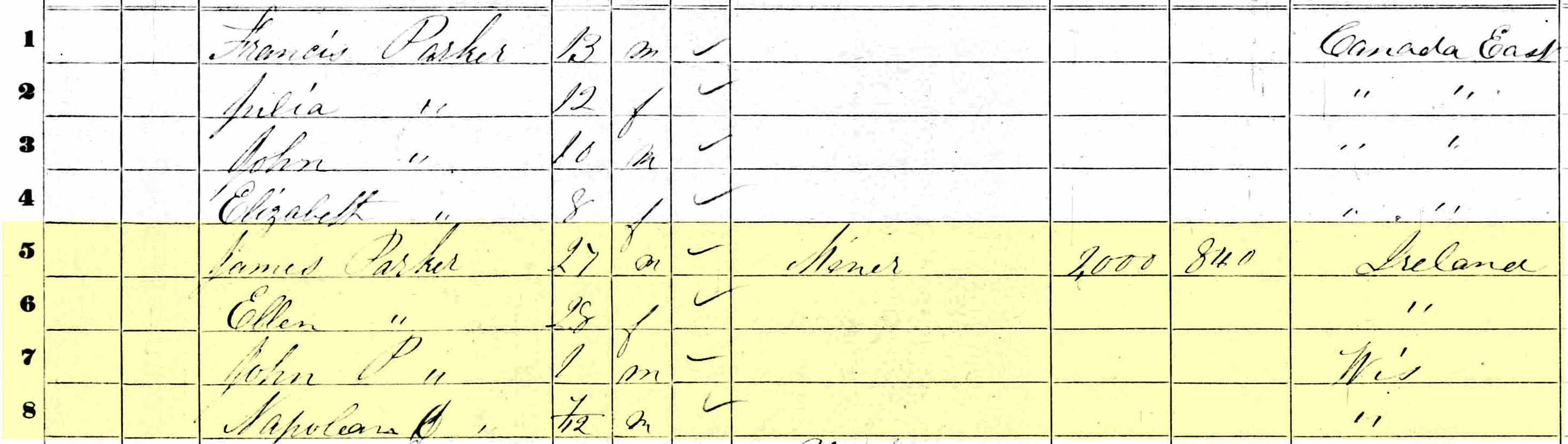
There is a James Parker who appears in the 1852 Census of Canada in the vicinity of Patrick Parker’s family. He’s born about 1832 in Ireland. However, that census does not list relationships so there’s no telling if he’s a son or some other relation to Patrick. In the 1860 US Census, there’s a James Parker living with Patrick Parker’s family in Glen Haven, Wisconsin. The age listed would put his year of birth about 1832, also in Ireland. Listed below him are Ellen, John and Napolean Parker. The 1860 US Census also does not list relationships, so it’s not certain how they relate to Patrick either. But the placement is typical of an adult son who has married but is still living in the same household as his parents. It’s not certain by any stretch of the imagination, but it’s the most likely possibility.
James, Ellen, John and Napolean Parker in Glen Haven
I’ve researched all the other children of Patrick Parker and Mary Murphy who showed up in the United States, and have had some luck with tracking many of their descendants who lived mostly in Iowa. But this James disappeared after 1860.
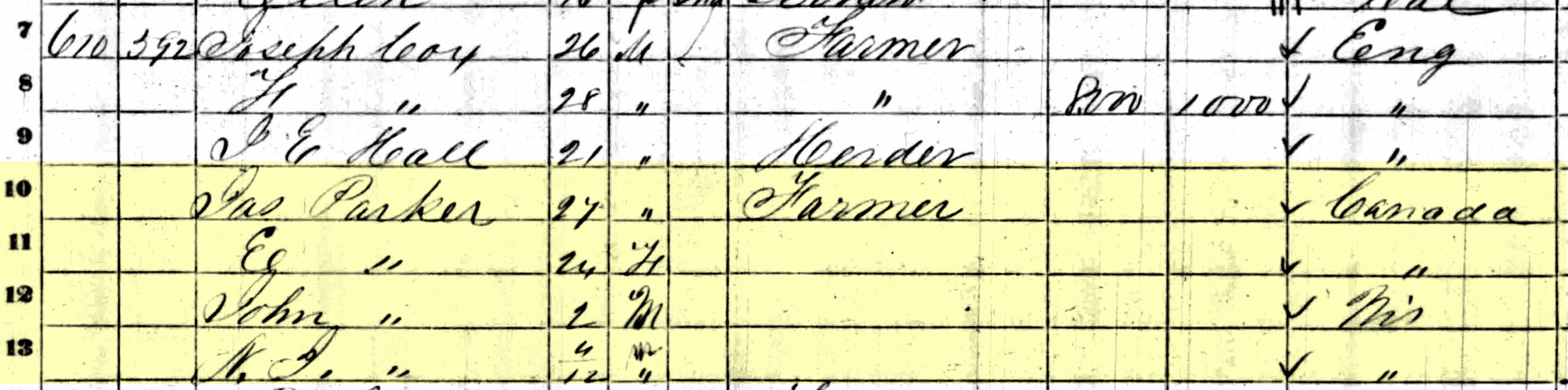
And last night I found something intriguing. There appears to be a very similar entry for another James Parker in San Joaquin Township, Sacramento County in California, also in 1860.
James, E., John, and N.J. Parker in San Joaquin
Listed with this James Parker are an E., a John, and an N.J. Parker. They have similar ages, though slightly different. They are listed as from Canada and Wisconsin rather than Ireland and Wisconsin. But remarkably similar overall. At this point, I don’t have anything to corroborate this record.
It was at this point that I started writing this post, thinking that I had a something interesting to follow up on for later.
However, as I am wont to do, I added this to my Ancestry.com tree for James Parker. I treat my Ancestry.com tree as a database of possibilities. I’ve even posted a note on it warning other people they should copy my tree at their peril. When I posted this census entry to the family of James Parker, Ancestry went to work and started matching new records. Now that they live in California, it starts ranking California based records higher in its sort. Nothing popped up for James Parker, but four new census entries showed up for John Parker, born in 1858 in Wisconsin and living in California.
The first of these is a John Parker living in Santa Barbara in 1900 with wife Margaret and children John Warren, Mary Ellen, James Galen, and Ruth M. Now, this is also no guarantee that this is the same John Parker. In fact, the link was tenuous enough that I did not add the record to my entry for John Parker even with the database of possibilities caveat. It would just be too hard to unwind if it turned out to be wrong. So I created a new, disconnected family for a new John Parker and recorded it. If the research was a dead end, I could just delete them all, I wouldn’t have to disconnect them from the known Parker tree, and everything would be good.
Family of John Parker in 1900
I also added the 1910 US Census entry for the family (image not included with this post). This one had the same children, except that Mary Ellen is listed as Inez in 1910. Other people on Ancestry had added these two census records to families headed by a John Parker and Margaret Miscall.
The next step in this bread crumb trail of discovery is an entry in Ancestry.com’s California Death Index. The California Death Index is just a list of death certificates that were filed with the state between 1940 and 1997. It’s not a dispositive record without seeing copies of the underlying certificates, but I’ve generally had good luck with the index being correct. I haven’t seen the errors for the database that I’ve seen with other transcriptions.
The entry that I found was this:
Name:	Mary Elleninez Gerard
[Mary Elleninez Parker]
Social Security #:	563325739
Gender:	Female
Birth Date:	1 Nov 1890
Birth Place:	California
Death Date:	5 Jun 1981
Death Place:	Orange
Mother's Maiden Name:	Miscall
Father's Surname:	Parker
Mary Elleninez Gerard (neé Parker)? That looks really promising, I thought to myself. Date of birth matches up, and the parents’ surnames match up with what other people had found for John and Margaret. None of those researchers had linked the record to Mary Ellen Parker however. Nevertheless, I added a husband to her with a last name of Gerard so that Ancestry’s search engine would look for her as part of a Gerard family. Nothing popped up immediately.
And nothing else popped up for any of the other family members at the time either. I haven’t been doing real research in this process. This is just following my nose and poking around. It’s late at night and I should go to bed. However…
Last year my great grand aunt Frances died at the age of 103. In June of this year, I picked up five boxes of photos and other personal effects that had been in her possession from a cousin. I’ve been paying my friend Kim to scan all these items so they’d be available for everyone in the family. One of the items is an album containing photos from what appears to be trips my great grandparents Joe and Frances Weiss took. They visited relatives in Colorado, Illinois and California. And toward the back of the album was a photo of a nun with an inscription that appeared to be Sr. M. Germaine Parker. It’s hard to read.
I’ve thought Sister Parker might be a connection to one of the two missing branches of the Parker family. In addition to James Parker, there’s also another John Parker who went missing in records after 1880. He probably exists somewhere, but John Parker is such an incredibly common name and records from the 1800s are often sketchy. I haven’t found anything that matches up with him.
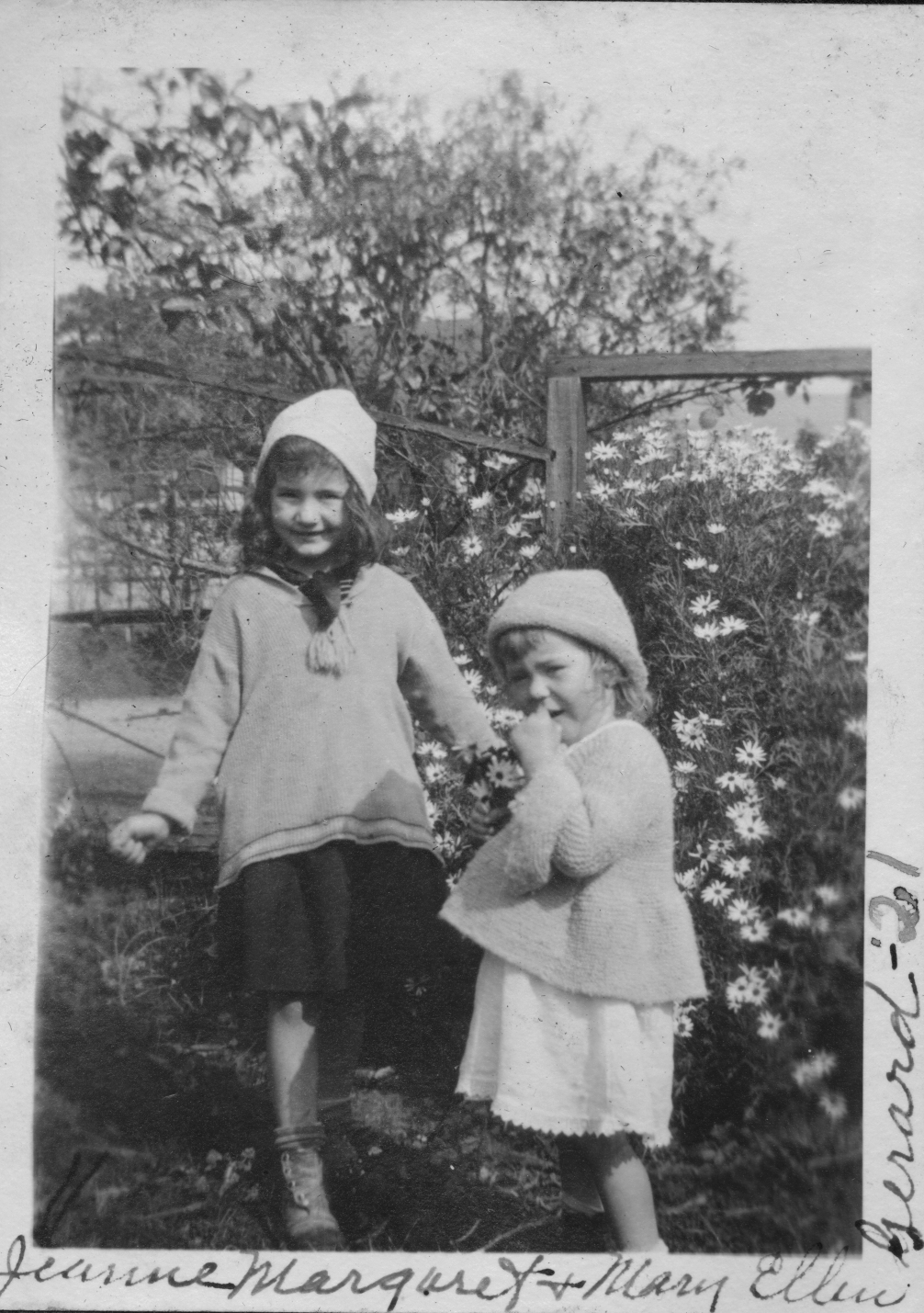
So I pulled out the album and looked for the photo. Sister Parker looks to be in her 30s or 40s, though it’s quite hard to tell with her habit covering everything except her face. I flipped backward through the pages of the album looking for other photos of her. And then I saw this photo:
Jeanne Margaret and Mary Ellen Gerard – ’21
Gerard! Mary Ellen Inez Parker Gerard! Could these be her children? Must search harder for her! And bingo! In 1920, there’s this census record:
Henry Gerard – 1920 in Los Angeles
Henry and Inez Gerard, living on Gardner Street in Los Angeles with children Jeanne and Mary Ellen, aged 4 and 1¼ years old. Those are the two girls from the photo. And Inez matches up with the daughter of John Parker.
And the most likely reason my great grandparents would be visiting the Gerard family that matches up with this trail is because they are related.
This is just the beginning. I’ll have a lot of hard work to prove all of this. That record for James Parker may be incorrect. James may be a cousin of my great great grandmother Mary Parker and not her oldest brother. James himself may disappear from available records. But my great grandparents did not visit the Gerard family randomly.
This is why family genealogists should research the descendants of their ancestors. The descendants provided the link that may lead to valuable information about James Parker and ultimately my third great grandparents, Patrick and Mary Parker. had I not gone down the tree, James Parker may have remained among the disappeared.
A gave myself a couple of tasks to accomplish yesterday before the second session of my genealogy class. The first was to pick up the class packet from the copy center. The second was to pick up a Husky Card for access to the U.W. libraries. Both went swimmingly, so I got to my class early, hung out and read the text book.
The class was taught by James Rigali today. He’s the instructor for the history portions of the class. Topic was Organizing Historical Research Projects. After an overly long and fairly unimportant discussion of what is history? he delved into a basic method he wanted us to follow:
Pick a subject. At this point, I’m thinking of doing my project on either or both of my third great grandparents, Patrick Parker and Mary Murphy. (I’ve written about them on the blog before.)
Create an annotated chronology
Develop research questions, both historical and genealogical
Develop a bibliography. His overview included the following types of sources:
General books, including textbooks.
Scholarly articles (JSTOR)
Encyclopedias (he didn’t cover this one too much)
Historical books and magazines published at the time
Local histories
Historical maps
Historical photographs.
Newspapers of the time
History web sites
Sample Research Journal
Keep a research journal. He didn’t really cover what to record on this, other than keeping what he called a two-sided journal. In other words, record what you are searching and reading on one side, and notes and thoughts on the other. He didn’t really seem like he’s embraced computer technology like I do.
Tonight was the first session of my Genealogy and Family History class through the Continuing Education office at U.W. I don’t have a whole lot to report about the experience, as we did not cover any academic material today. The first half of the class the instructors reviewed the syllabus and their expectations. None of the work appears to be particularly difficult. Assignments include things like retrieving and printing a page from the census and requesting a vital record.
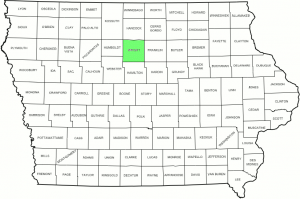
Wright County Iowa
The second half of the class was dedicated to student introductions. Not so much tell us a little bit about yourself as tell us a little bit about your family. Throughout the introductions, whenever someone mentioned Iowa the genealogy instructor (the other instructor focuses on history) asked what part of Iowa. She mentioned she had a lot of interest in one county. About the 4th time she asked about Iowa, I realized that her name has been ringing a bell in the back of my head, and I realized why. She runs the GenWeb site for Wright County, Iowa. As I’ve documented here, my third great grandparents Patrick Parker and Mary Murphy Parker appeared to have ended up in Iowa. Four or five of their children were in Wright County Iowa, two others in Franklin County, the next county over.
I’m being taught by a person who has expertise in the genealogy and history of a specific county I’m interested in.
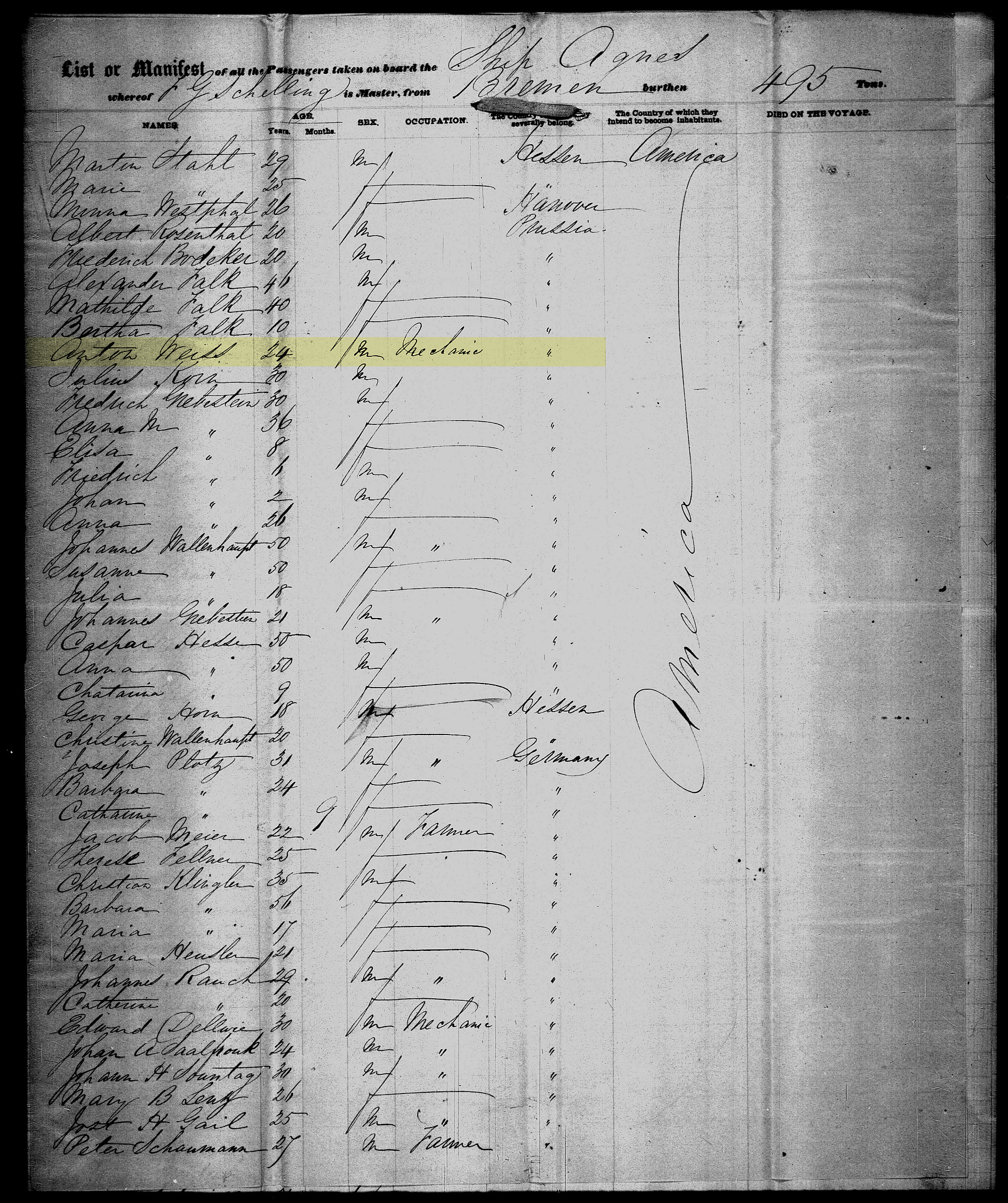
I think I’ve found the correct passenger manifest which shows my great great grandfather Anton Weiss arriving in America.
Anton applied for a passport in 1886 stating that he emigrated from Bremen on 4 Mar 1852, however he forgot the ship’s name.
On 9 Apr 1852 the Agnes arrived in New York from Bremen with an Anton Weiss aboard. He’s 24 years old, from Prussia, and his occupation is mechanic. That’s doesn’t exactly match what I know about Anton Weiss, but it’s reasonably close. Anton was actually 25, from Bavaria, and worked as a tinsmith in the first references to his occupation in the U.S. Anton turned 25 on 27 Feb 1852. He could easily have been 24 when he first registered with the Bremen emigration bureau.
Anton Weiss on the Agnes passenger manifest
What clued me in to the manifest is an entry in the United States Germans to America Index, 1850-1897 for Anton Weiss. That lists a 24 year old Bavarian named Anton Weiss, occupation coppersmith, arriving in New York on the Agnes on 9 Apr 1852. I don’t know why this database lists him as Bavarian rather than Prussian or gives his occupation as coppersmith instead of mechanic. This entry matches what I know about Anton Weiss pretty closely.
Coppersmith, tinsmith, and mechanic would have been very similar occupations in the 1850s. That discrepancy doesn’t bother me.
The discrepancy that bothers me is the scanned microfilm image gives his origin as Prussian. Bavaria and Prussia were were not interchangeable countries in 1852. Indeed, several other passengers have their origin listed as Hesse, Hanover, and Germany. So where the Germans to America Index gets Bavaria, I don’t know. Stuff to research!
I have a great great uncle, Frank Weiss, who moved from the family home in Cassville Wisconsin to Pukwana South Dakota. He married Nannie Conaway in 1890, and they had 4 children. Robert died young, and the other three were Marion, Theodore, and Agnes.
I think I just solved some puzzles that in retrospect shouldn’t have been all that difficult to figure out.
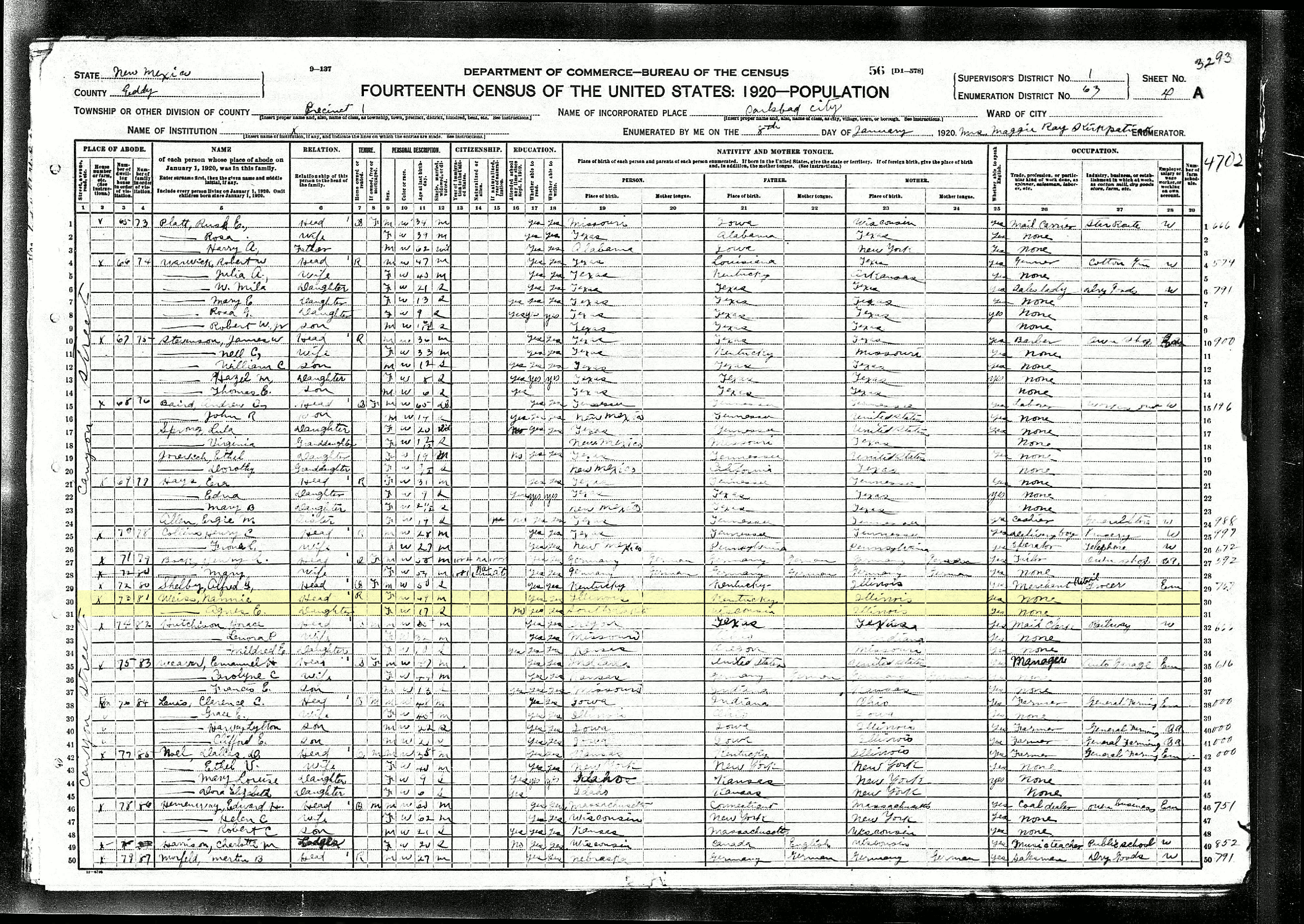
The first is that I found a census entry for Nannie Weiss living with Agnes Weiss in Carlsbad, New Mexico in 1920. Nannie and Agnes were also listed in Pukwana in 1920. I found the New Mexico entry several years ago and wondered what that was about. Vacation?
New Mexico?
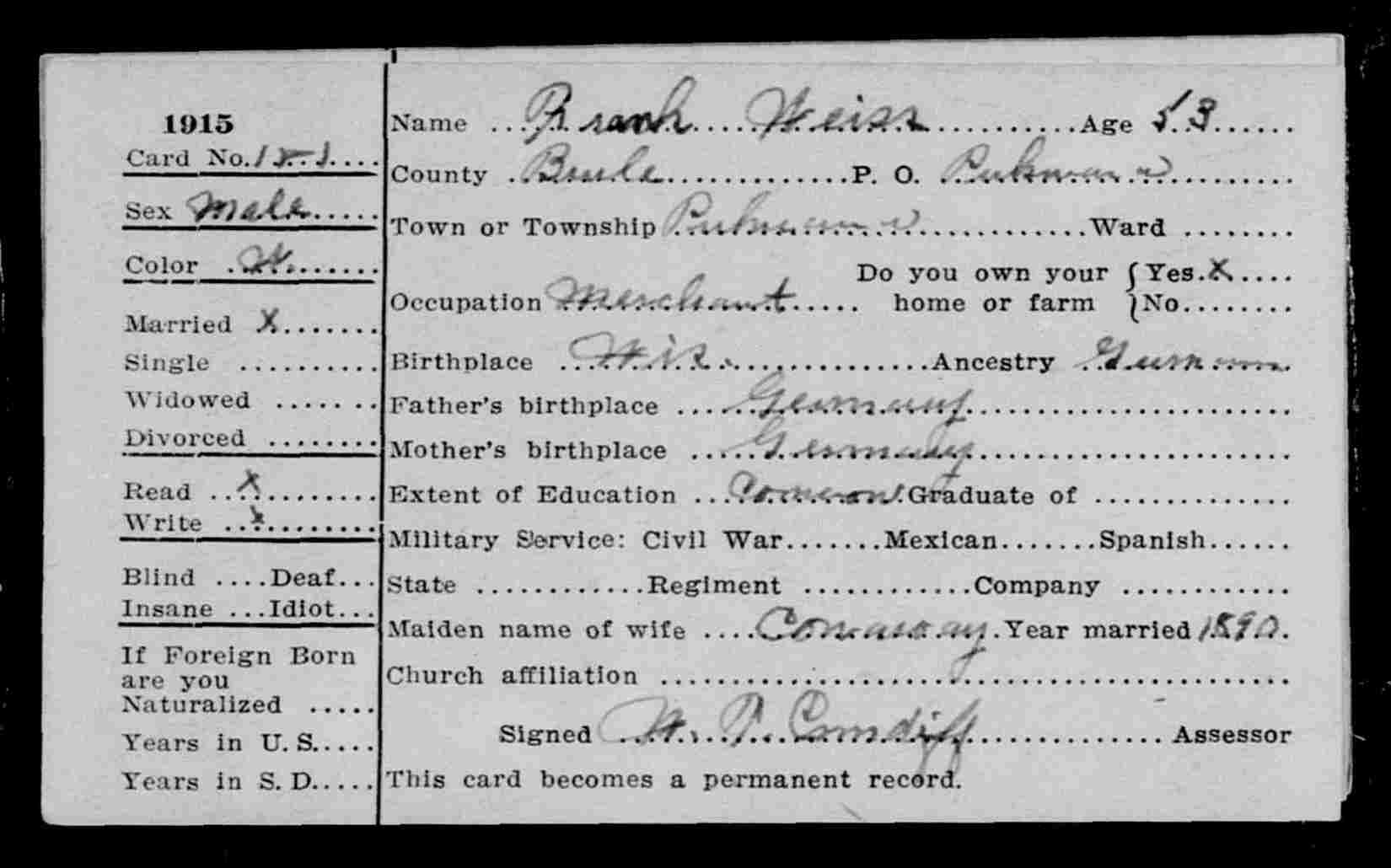
The next part of the mystery is the 1915 South Dakota state census. The only member of the family I could find was Frank Weiss.
1915 South Dakota state census card for Frank Weiss
I figured Marion being missing was because she was attending the University of Illinois, as she graduated in 1917. And maybe Theodore was off working somewhere. And not finding someone in the records in a place I know they should be is very common. Records are spotty. I got a letter just yesterday from the Social Security Administration saying they had no record of my grandfather’s death, so they could not release information about him to me. Missing records are a common problem. I didn’t think too much of the missing members of the Weiss family.
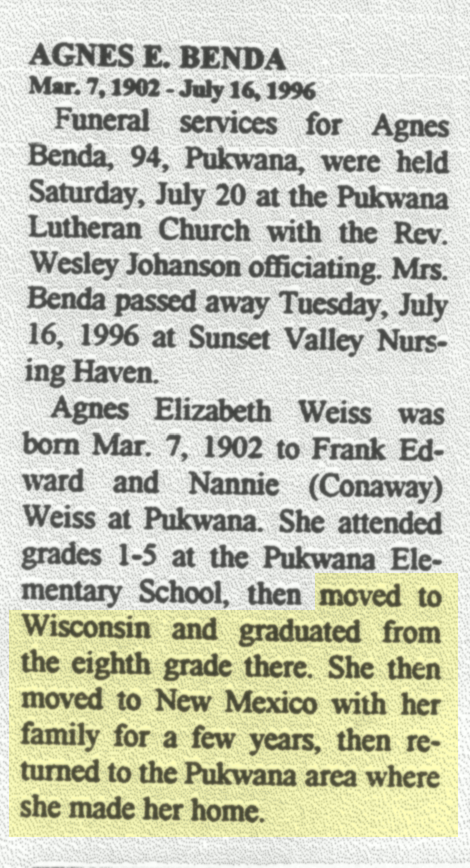
Agnes Benda obituary
The last puzzle was Agnes’ obituary. It mentioned that Agnes finished 8th grade in Wisconsin and then moved with the family to New Mexico for a few years. For some reason, I never connected that with the other pieces of information. The obituaries for Nannie and the other children never mentioned anything about New Mexico. In fact, Theodore’s said he lived in Pukwana his entire life save for the time he spent in the military.
It appears now that Nannie moved with the kids who were still at home. In 1915, the county assessor who conducted the census didn’t include them because he knew they didn’t live there. But the US Census in 1920 asks who normally lived in the domicile. And to Frank, Nannie and his children normally lived there, so he included them in his responses. At the same time, Nannie also answered the queries as if she normally lived on her own with Agnes in Carlsbad, New Mexico.
The questions the records don’t answer is why Nannie took the kids and moved out for a time? There’s all sorts of possibilities, from domestic trouble to plans for the whole family to move to New Mexico that fell through. Perhaps the family fell on harder times and Nannie took several teaching positions. And why New Mexico?
The last grandchild of Frank and Nannie died last September. A number of great grandchildren are still alive, but none of them were older than 4 years when Nannie died in 1959. Unless Frank or Nannie wrote it down somewhere, I won’t get a chance to hear the story from someone who heard it directly from one of the participants.
That’s why when I meet distant relatives, I don’t ask them about names and dates. I ask them to tell me stories.
I have bad luck with Costco detergent and cars. Two years ago I had a sweet smell coming from the back of my car that turned out to be one of those big Costco laundry detergent containers having popped open and poured liquid detergent all over the back of my station wagon. Had to pay to have car detailed. Extra even, cause the battery is back there.
Unloaded my car last night and saw a smear of white stuff in the back. I thought it was potato salad. Then I got inside and saw the container of liquid dishwasher detergent which I had unloaded from the car earlier in the day and left on my counter. A large portion of the detergent was in a giant puddle on the counter and a smaller portion dripped over the side onto the floor, all having leaked from a nail sized hole in the side of the container. I’m afraid to go back out to check my car because I don’t want to have to get it detailed again.
Kate Martin’s top priority for transportation is the following: Decongest bus and street car routes to improve reliability. The following blog post talks about how she intends to do that: Congestion Rx
(Credit: King County voters’ pamphlet)
Do you see any solutions in that? I don’t. What I see is a cranky neighbor who’s mad that bus drivers are getting overtime. Please explain to me how reducing overtime will materially improve bus service.
She’s got a few other blog posts on transportation as well.
Her solution to road rage? Take bikes off the roads and put them on “Greenways.” I love the idea in theory. In practice, this isn’t going to work for a number of reasons. First, Seattle’s geography means that there are number of choke points where bicycles and vehicles will have to share space. Second, given the realities of cranky car people, bicycle roads are going to be shunted to corridors that are a pain in the ass for bicyclists. Is she going to push to turn Roosevelt way or 15th Northwest from a car through-way to a bicycle through-way? I doubt it. Is she going to make it so that bicycle crossings have equal or higher priority at crossings with cars, or will it be like the Burke Gilman trail where every crossing means bicycles have to stop and wait for a cross-walk light? It’s going to be the latter, and that will make it impractical for bicyclists to commute on a greenway.
Rather than extend Link to Ballard, Kate Martin wants to add a Sounder Commuter stop in West Ballard. Where those tracks go is nowhere near the population centers of Ballard, and people aren’t going to walk that far. This would mean that the station would need a large garage for Park-n-Riders. The train ride would also put commuters at the Amtrak station at the very south end of downtown. That makes sense for people commuting a long distance (the nearest stations are Longacres and Edmonds) where the distance to offices from the station, while a chunky amount, are but a fraction of the total commute. But for commuters from Ballard who need to get to Belltown or north downtown? They’re not going to want a walk that is as long as their train ride to downtown in the first place. A Link route with stops in Interbay, Ballard proper, Loyal Heights and Crown Hill is going to serve commuters a lot better than a Sounder stop.
Or take for instance her priority of “Rebuild the Seattle Police Department”. Here’s how she would do that: SPD: A Path Forward.
Yup, her main idea is to get a strong leader. Duh. Nothing about body cameras, or tracking race to see if the SPD is biased, or getting people who live in Seattle to be officers, or new training programs. Those are ideas from other candidates. They may or may not work, but they are pro-active ideas at least. Kate Martin? In her other blog post on crime wants to target “incivility”: Crime and public safety. What that amounts to is that she wants all the people that annoy and scare her out of downtown, the poor people, the homeless people, the crazy people. Then women will come downtown again!
Sorry Kate Martin, you are a no go for me. A good portion of your policy ideas are dog-whistle items for NIMBYists, not forward-thinking prescriptions for an urban city.




 I have bad luck with Costco detergent and cars. Two years ago I had a sweet smell coming from the back of my car that turned out to be one of those big Costco laundry detergent containers having popped open and poured liquid detergent all over the back of my station wagon. Had to pay to have car detailed. Extra even, cause the battery is back there.