This proposition pisses me off for two reasons. The first is that we have to even have to vote for it at all. The Washington State Legislature has failed for years to give King County the authority to fund Metro in a sustainable fashion. So now we’re stuck with two options: cut Metro service by huge amounts or use regressive sales and vehicle taxes to fund it. While the latter option sucks, it’s better than cutting bus service. The second reason is that we aren’t using 100% of the proceeds to pay for bus service. We’re using 40% of it for roads. Theoretically, road maintenance rather than construction. But still, Metro needs the money.
So here’s what happens if we pass it on the revenue side: a sales tax of 0.1% and $60 dollar vehicle tab fee ($20 more than current fees), with a $20 rebate for poor people. On the expense side: $80 million per year for Metro which will stave off cutting 5 dozen routes completely and reducing service on tens of others. $50 million goes toward maintaining roads and road safety.
The anti-proposition 1 side says Metro needs to cut costs first. Metro has already cut $130 million in annual costs. Really what these people are pissed about is that poor people who ride buses are getting a freebie. That’s what they think, that transit riders are getting a subsidy while respectable drivers aren’t etting one. Never mind that they already have huge road subsidies.
I have a car. I am happy to pay the $60, and I won’t get the subsidy. But I also ride the bus. Metro service is more convenient than driving much of the time, and necessary for many people. It reduces greenhouse gas emissions over driving. It reduces congestion for cars. There are all sorts of benefits from bus service. We need Metro. It’s as simple as that.
I successfully made cookies for the first time last week. Every other attempt failed miserably, to the point where I’d given up. Cookies are supposed to be easy, but apparently not for me. I’d been invited to an event where cookies were expected, so I gave it a go.
I found this recipe in an old Better Homes and Gardens cookbook called Cookies for Kids. It has photos of kids aged 5 to 10 years old making cookies in it. I figured this would be hard for me to screw up.
I doubled the recipe from the book though. I think it worked out better because there was more stuff for the mixer to work with and so it all got mixed better. Directions below are how I did it, not a copy from the book.
Equipment
Stuff I need to make sure I have cleaned and available.
large mixing bowl
medium mixing bowl
small saucepan
hand mixer
2 cookie sheets
parchment paper
storage bins for finished cookies
bowl for drained cherries
cup to hold cherry juice
Ingredients
butter, 2 sticks, room temperature
sugar, 2 cups
eggs, 2
vanilla extract, 3 teaspoons
all purpose flour, 3 cups
unsweetened cocoa powder, 1 cup
baking soda, ½ teaspoon
baking powder, ½ teaspoon
salt, ½ teaspoon
maraschino cherries, 2 jars (this was overkill, but I used more than 1 jar worth)
semisweet chocolate chips, 12 ounce package
sweetened condensed milk, 1 cup
Instructions
Add butter and sugar to a mixing bowl
Beat with a hand mixer until fluffy and thoroughly mixed
Add eggs and vanilla
Beat well
In another mixing bowl, stir together flour, cocoa powder, baking soda, baking powder, and salt
Add part of flour mixture to butter mixture
Beat until well mixed
Repeat last two steps until all of the flour is combined with the butter
Shape the dough into 1 inch balls, placing each on parchment paper on a cookie sheet about 2 inches apart (made enough to fill about 2½ sheets)
Press thumb into the middle of each cookie, squashing them down
Drain cherries, reserving the juice in a cup
Put a cherry in the indentation in each cookie
Combine chocolate chips and condensed milk in a saucepan
Melt over low heat, stirring occasionally
Stir in enough cherry juice to make the chocolate spoonable
Spoon a dollop of chocolate over each cookie, enough to cover the cherry
Bake at 350° til edges of the cookies are firm (was about 13 minutes for me, book said 10)
Transfer cookies to a cool surface to cool
Gallery of photos at most steps taken below. Forgot to take photos of the finished cookies, which were tasty, by the way.
After a couple of years of little progress mostly due to focusing on other parts of my family tree, I’ve been making huge progress with the Parkers. You’ve probably noticed the multiple posts about them recently.
A few weeks ago, I noticed there was a Find-A-Grave memorial for a Leonard Parker at the church cemetery in Saint Mary, Ontario. Leonard Parker is reputed to be the brother of my ancestor, Patrick Parker. I wrote to the person who put up the memorial, asking if they were related. The answer was yes, and we exchanged some information about our respective family trees. One of the things she clued me in to was that the parish registers for some of the Roman Catholic churches have been scanned and are on FamilySearch. Not indexed, but available.
Which brings me to my great great grandmother, Mary Parker Ryan. She married William Dennis Ryan in 1864, had six children, and died of typhus in 1875, not quite eleven years into her marriage. She had a short and somewhat forgotten life. Every time I mentioned her to one of my relatives, I get blank looks. Apparently my great grandparents and grandparents generations talked so rarely about her that no one in the next generation had heard of her. That sort of reaction is part of why I’ve been drawn to genealogy, to remember the people who haven’t been.
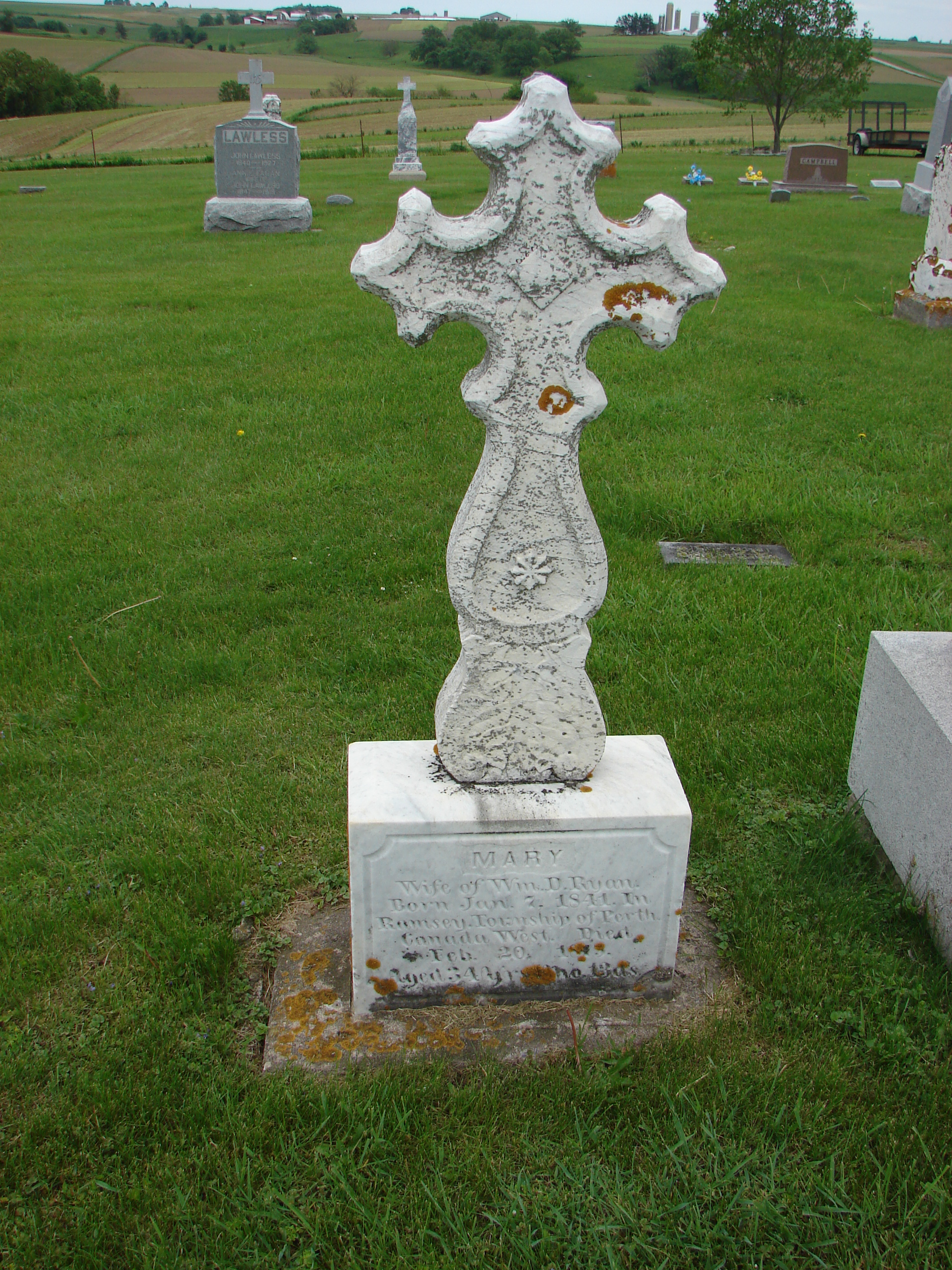
The main source of information I had on Mary was her grave monument in a small cemetery on a hill about a mile east of Patch Grove, Wisconsin. I visited Saint Johns Cemetery in June 2011.
Grave marker for Mary Ryan
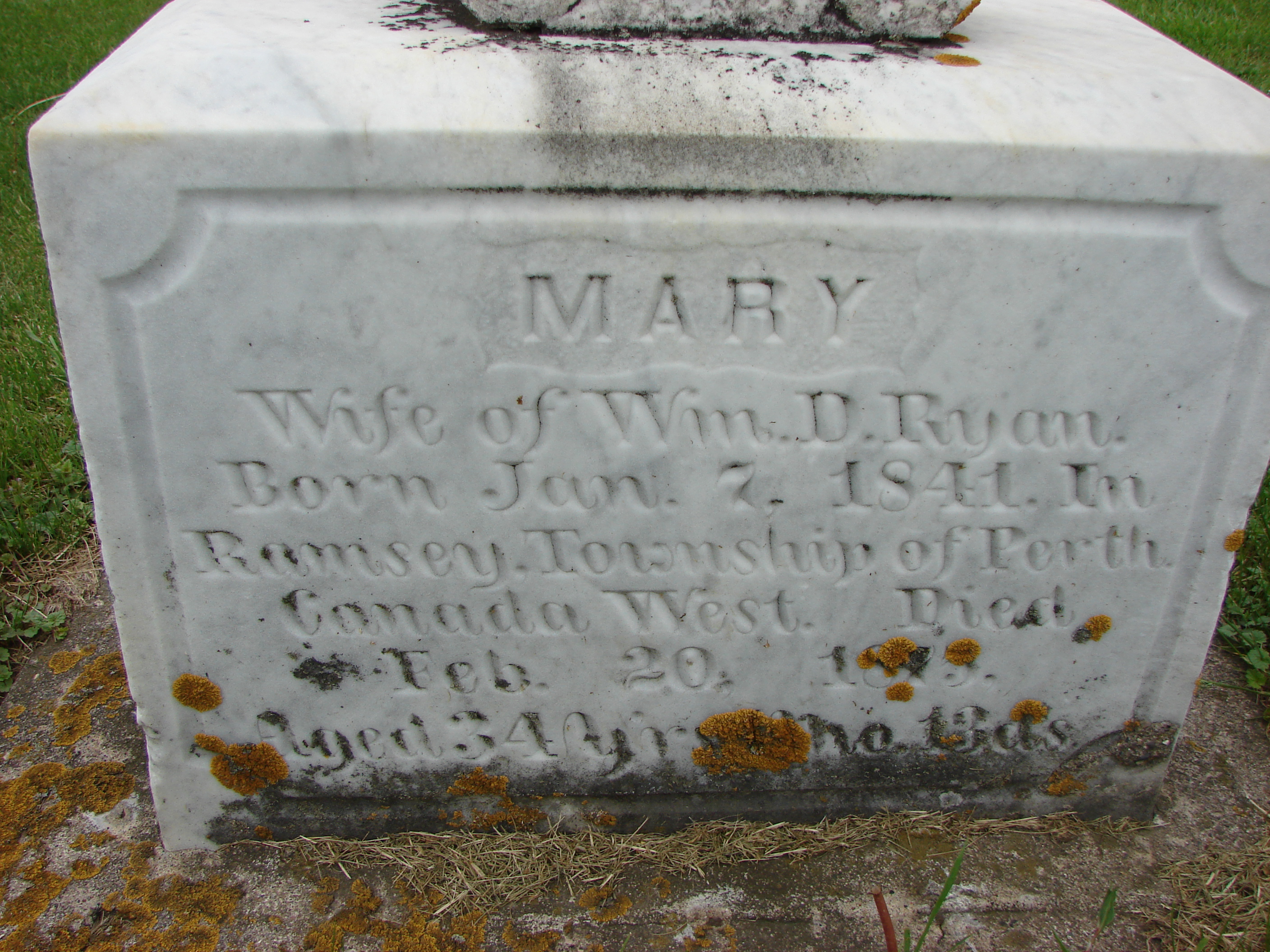
It’s quite a nice monument for the time. William Ryan cared enough to spend some dough on it. Here’s a close up of the inscription.
inscription on Mary Ryan’s monument
It reads:
Mary
Wife of Wm. D. Ryan.
Born Jan. 7, 1841. In
Ramsey, Township of Perth.
Canada West. Died
Feb. 20, 1875,
Aged 34 yrs. 1 mo. 13 ds.
The inscription has a number of problems with it. The Parkers lived for a time in Blanshard township in Perth County, Canada West. There is no Ramsey township in Perth County, and as far as I can tell, there never has been. The only Ramsey township I’ve been able to find is in Lanark County, Ontario. That sort of fits with another family legend, that Mary’s mother was one Mary Murphy who was part of the Peter Robinson settlement of Canada. One of those settlements was in Ramsey township. I have doubts as to whether Mary Murphy really was part of that endeavor, but there’s a geographical connection at least. Oh, and the nearest city to Ramsey township is Perth. My working hypothesis was that this particular Ramsey was the one indicated on her grave.
Additionally, her death certificate and other accounts put her date of death as 23 Feb 1875. Three days difference isn’t that big of a deal. Still…
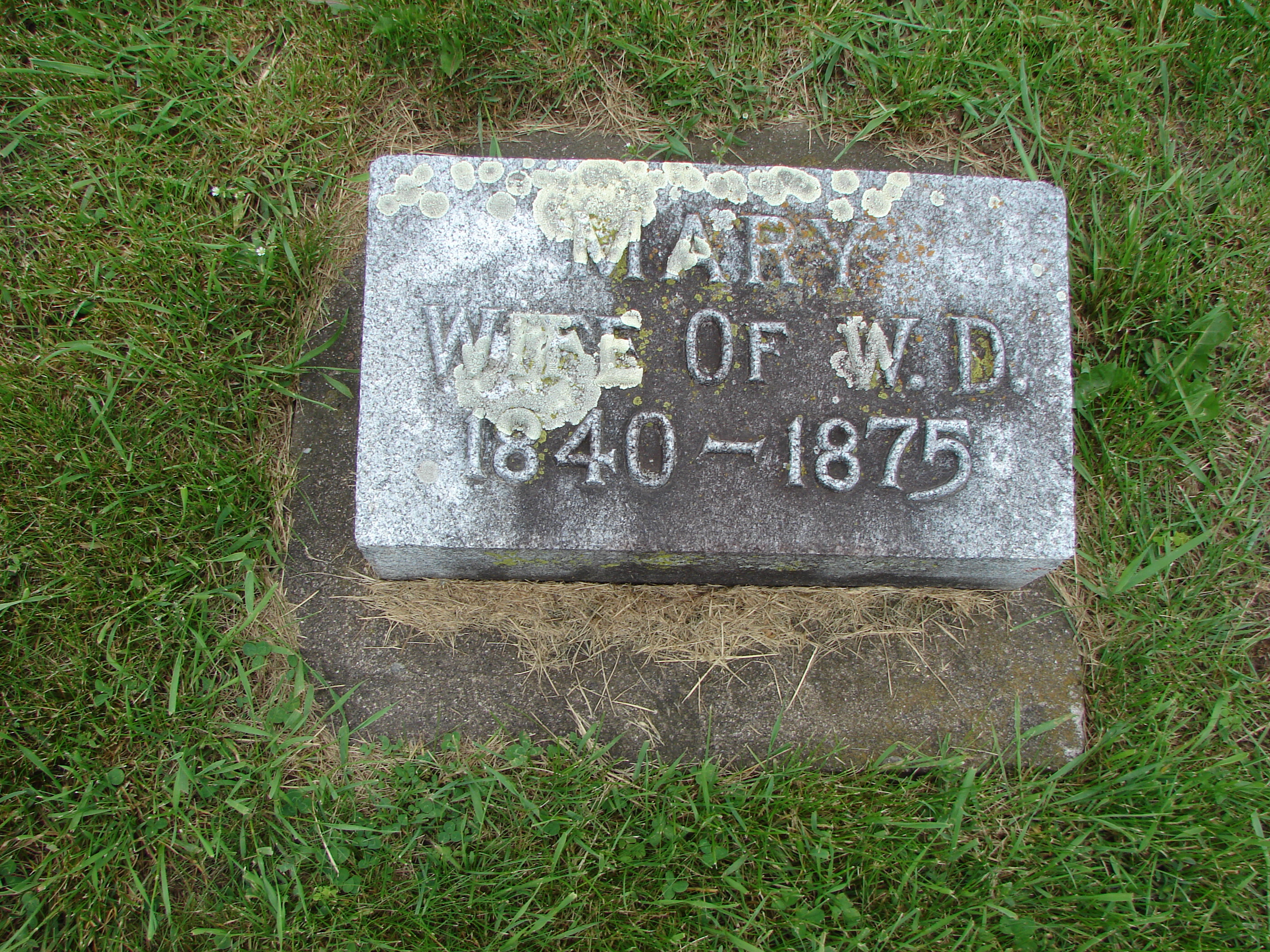
A further problem is that there is a second marker for Mary in front of the monument:
Second marker for Mary Ryan
You’ll notice this one gives a year of birth as 1840, rather than 1841. Rather confusing.
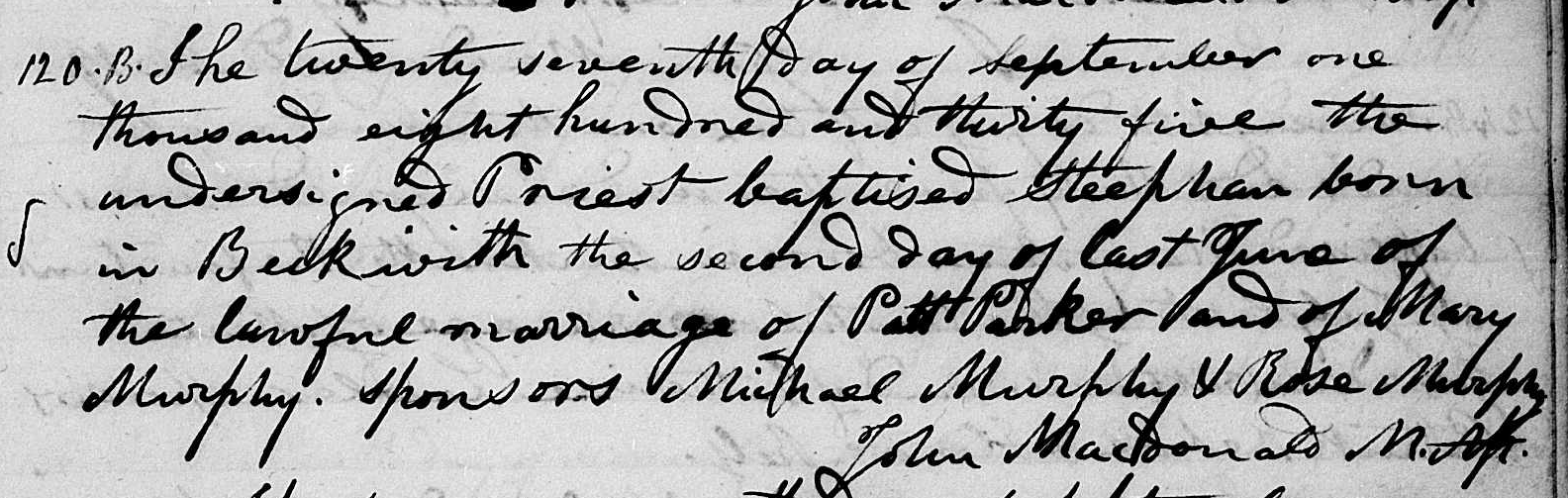
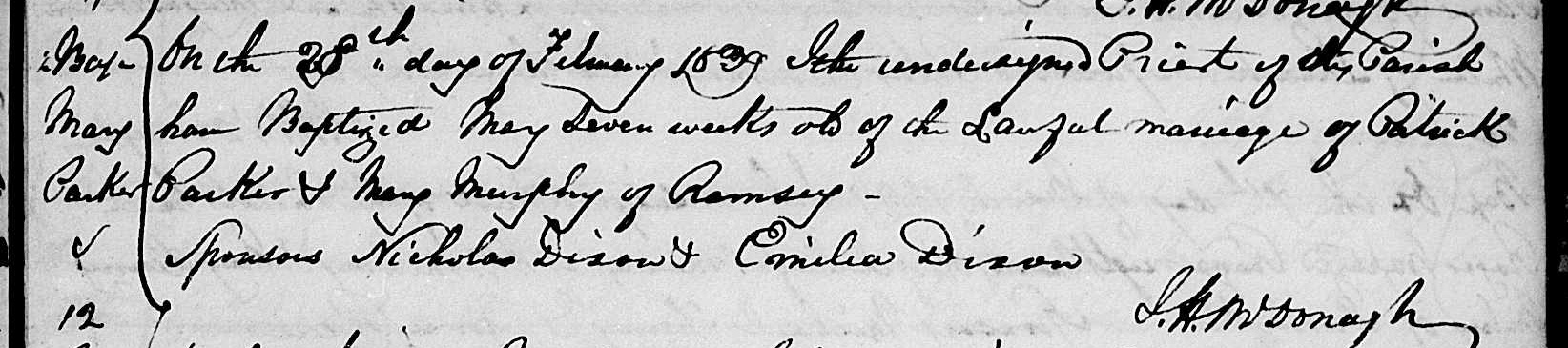
And, as it turns out, both are likely wrong. Going back to the thing above about the Ontario parish registers being online… I looked at the register for Perth’s Saint John the Baptist parish. There was no entry for Mary Parker in 1841. Her brothers Stephen and Patrick were there in 1835 and 1837, but no Mary. On the first perusal, I missed it. But on the second look through, I saw an entry for a Mary Parker in 1839:
Mary Parker baptismal register entry
On the 28th day of February 1839 the undersigned Priest of this Parish
has Baptized Mary seven weeks old of the lawful marriage of Patrick
Parker & Mary Murphy of Ramsey.
Sponsors Nicholas Dison and Emilia Dison
That’s an entry in a contemporaneous journal of parish actions. Unless it’s for a different Mary Parker, it’s pretty convincing evidence she was actually born in January 1839. January 7th fits, so I’m guessing that’s her actual birthday.
However, by the time the monument was erected, people were guessing at her actual age. Maybe she’d shaved off a couple of years. Maybe she forgot or didn’t know. Maybe the monument was erected years after her death. I’ve no idea the reason.
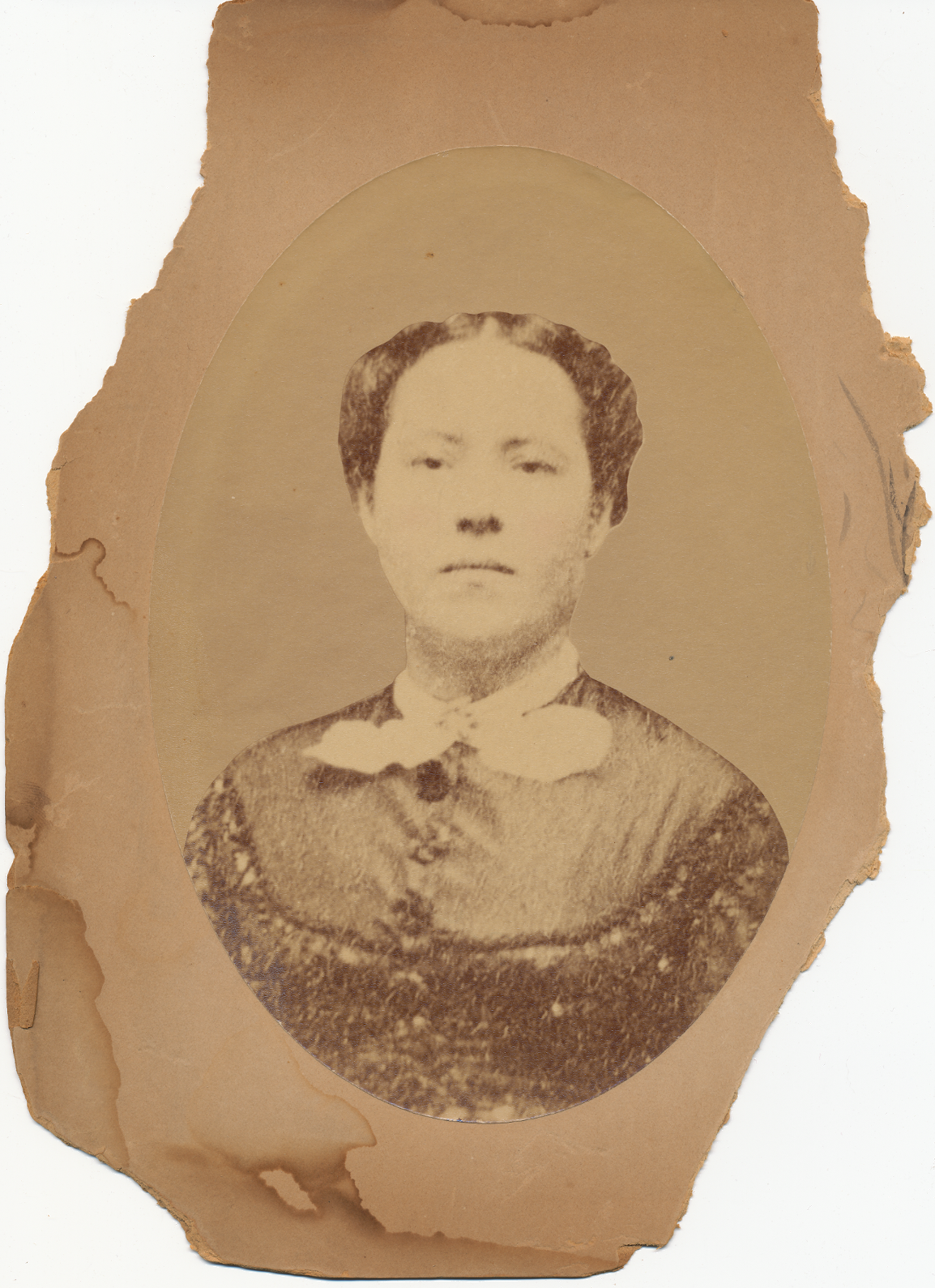
As an added bonus for this post, among the effects found in my great aunt’s house last year when she died was this photograph:
Mary Parker
On the back is the inscription “Mary Park” and the paper is torn. Is it my ancestor or another Mary Parker or did whoever wrote the inscription just guess? I’ve no idea.
Alex King is the creator of the Share Icon. I can’t say whether he still owns the copyright or not, but the the thing about Creative Commons licenses is that they are irrevocable. ShareThis Inc., or whatever their legal name is, cannot revoke the license.
So long as I give credit to Alex King (which I just did) and link to the license (which I just did), I can use this image however I want, per the terms of the license:
You are free to:
Share — copy and redistribute the material in any medium or format
Adapt — remix, transform, and build upon the material for any purpose, even commercially.
There was another item in the map I found yesterday that is of interest to me. On one of the other sheets is a city map of Cassville, where my great great grandfather Anton Weiss operated a hardware store for close to 50 years.
Just as I was able to find Patrick Parker in Glen Haven, Anton Weiss store shows up in this map too:
Map of Cassville in 1868 showing Anton Weiss
Here’s what the location looks like today:
Denniston and Amelia, Cassville in 2013 (Google Street View)
I’ve made one visit to Cassville, but at the time I didn’t know the location of the family home.
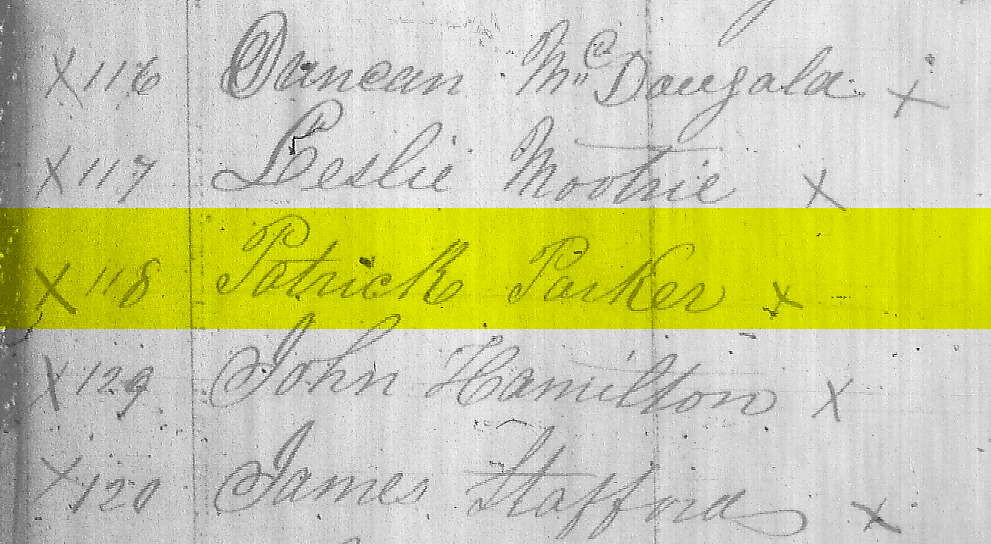
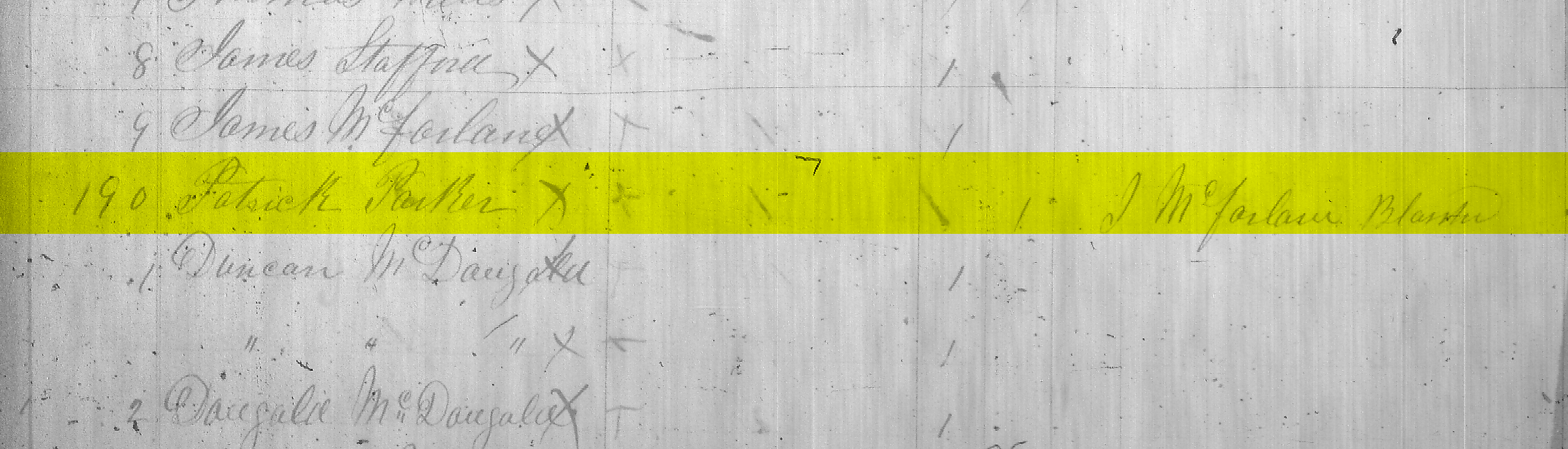
My genealogy white whale since shortly after I started has been finding Patrick Parker and his wife Mary Murphy. I’ve written about them here multiple times. I’d found pretty solid evidence on what happened to 8 of their 10 children, the only two where I was missing basic information were the sons James and John. Last month I found good evidence for James. Two weeks ago I found John, though I haven’t pursued it much yet.
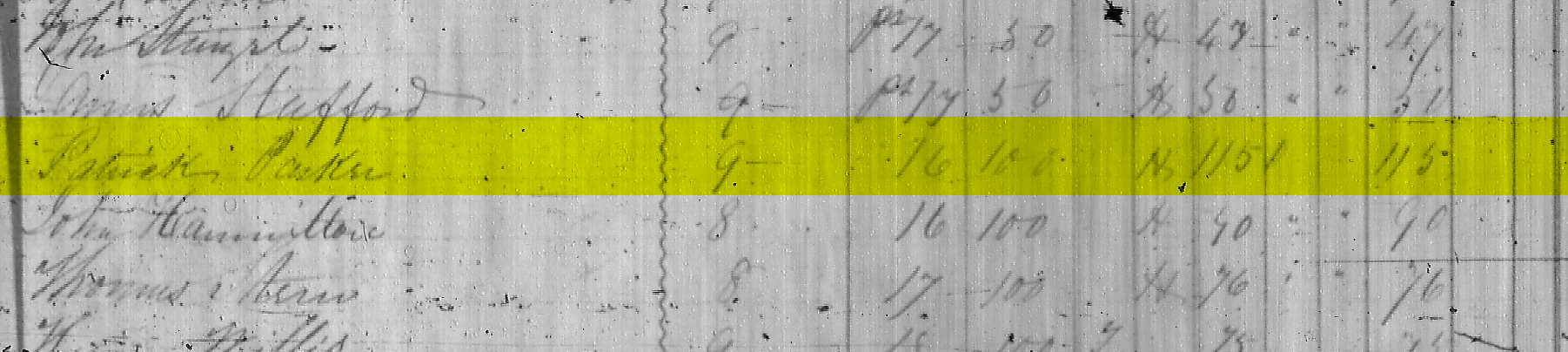
But as much information as I’ve found on all their children, the evidence I have for the pair themselves is aggravatingly small. I’ve located them together in the 1851 Canada Census, the 1860 US Census, and the 1870 US Census. I have a possible grave site for Patrick in Iowa. And Mary Murphy can be found in the 1885 Iowa Census. That’s the sum total of direct evidence I have for them.
I have indirect evidence for them. I know they arrived in Canada between 1832 and 1835, based on the listed countries of birth for their children. The death records for several children list their names. The grave marker for my great great grandmother Mary Parker Ryan gives a place of birth for her, which places Mary Murphy in that place at least.
Today I was looking through the online maps collection for the Wisconsin Historical Society, and I saw they had added a map for Grant County from 1868, and the description included “shows townships and sections, landownership, …” The earliest landownership map for Grant County that I’ve viewed came from 1878 and the Parkers were not to be found on it. So, I took a peek at the 1868 map:
1868 map of Grant County, Wisconsin showing the Parker and Ryan farms highlighed
Lo and behold, there he is! The P. Parker farm is just southwest of North Andover (a town which is no longer a town). On the map, I also highlighted the location of the farm for Patrick Parker’s son in law, William Dennis Ryan. And with handy Google Maps, I can show you where the Parker farm is on today’s maps.
This is the first direct piece of evidence for their existence that I’ve found in nearly 2 years. You don’t know how thrilled I am about this.
I’ve previously written about Patrick Parker and his wife Mary Murphy. One of the family legends passed on to me by other researchers was that they had a son names James who went off to California, never to be heard from again.
There is a James Parker who appears in the 1852 Census of Canada in the vicinity of Patrick Parker’s family. He’s born about 1832 in Ireland. However, that census does not list relationships so there’s no telling if he’s a son or some other relation to Patrick. In the 1860 US Census, there’s a James Parker living with Patrick Parker’s family in Glen Haven, Wisconsin. The age listed would put his year of birth about 1832, also in Ireland. Listed below him are Ellen, John and Napolean Parker. The 1860 US Census also does not list relationships, so it’s not certain how they relate to Patrick either. But the placement is typical of an adult son who has married but is still living in the same household as his parents. It’s not certain by any stretch of the imagination, but it’s the most likely possibility.
James, Ellen, John and Napolean Parker in Glen Haven
I’ve researched all the other children of Patrick Parker and Mary Murphy who showed up in the United States, and have had some luck with tracking many of their descendants who lived mostly in Iowa. But this James disappeared after 1860.
And last night I found something intriguing. There appears to be a very similar entry for another James Parker in San Joaquin Township, Sacramento County in California, also in 1860.
James, E., John, and N.J. Parker in San Joaquin
Listed with this James Parker are an E., a John, and an N.J. Parker. They have similar ages, though slightly different. They are listed as from Canada and Wisconsin rather than Ireland and Wisconsin. But remarkably similar overall. At this point, I don’t have anything to corroborate this record.
It was at this point that I started writing this post, thinking that I had a something interesting to follow up on for later.
However, as I am wont to do, I added this to my Ancestry.com tree for James Parker. I treat my Ancestry.com tree as a database of possibilities. I’ve even posted a note on it warning other people they should copy my tree at their peril. When I posted this census entry to the family of James Parker, Ancestry went to work and started matching new records. Now that they live in California, it starts ranking California based records higher in its sort. Nothing popped up for James Parker, but four new census entries showed up for John Parker, born in 1858 in Wisconsin and living in California.
The first of these is a John Parker living in Santa Barbara in 1900 with wife Margaret and children John Warren, Mary Ellen, James Galen, and Ruth M. Now, this is also no guarantee that this is the same John Parker. In fact, the link was tenuous enough that I did not add the record to my entry for John Parker even with the database of possibilities caveat. It would just be too hard to unwind if it turned out to be wrong. So I created a new, disconnected family for a new John Parker and recorded it. If the research was a dead end, I could just delete them all, I wouldn’t have to disconnect them from the known Parker tree, and everything would be good.
Family of John Parker in 1900
I also added the 1910 US Census entry for the family (image not included with this post). This one had the same children, except that Mary Ellen is listed as Inez in 1910. Other people on Ancestry had added these two census records to families headed by a John Parker and Margaret Miscall.
The next step in this bread crumb trail of discovery is an entry in Ancestry.com’s California Death Index. The California Death Index is just a list of death certificates that were filed with the state between 1940 and 1997. It’s not a dispositive record without seeing copies of the underlying certificates, but I’ve generally had good luck with the index being correct. I haven’t seen the errors for the database that I’ve seen with other transcriptions.
The entry that I found was this:
Name: Mary Elleninez Gerard
[Mary Elleninez Parker]
Social Security #: 563325739
Gender: Female
Birth Date: 1 Nov 1890
Birth Place: California
Death Date: 5 Jun 1981
Death Place: Orange
Mother's Maiden Name: Miscall
Father's Surname: Parker
Mary Elleninez Gerard (neé Parker)? That looks really promising, I thought to myself. Date of birth matches up, and the parents’ surnames match up with what other people had found for John and Margaret. None of those researchers had linked the record to Mary Ellen Parker however. Nevertheless, I added a husband to her with a last name of Gerard so that Ancestry’s search engine would look for her as part of a Gerard family. Nothing popped up immediately.
And nothing else popped up for any of the other family members at the time either. I haven’t been doing real research in this process. This is just following my nose and poking around. It’s late at night and I should go to bed. However…
Last year my great grand aunt Frances died at the age of 103. In June of this year, I picked up five boxes of photos and other personal effects that had been in her possession from a cousin. I’ve been paying my friend Kim to scan all these items so they’d be available for everyone in the family. One of the items is an album containing photos from what appears to be trips my great grandparents Joe and Frances Weiss took. They visited relatives in Colorado, Illinois and California. And toward the back of the album was a photo of a nun with an inscription that appeared to be Sr. M. Germaine Parker. It’s hard to read.
I’ve thought Sister Parker might be a connection to one of the two missing branches of the Parker family. In addition to James Parker, there’s also another John Parker who went missing in records after 1880. He probably exists somewhere, but John Parker is such an incredibly common name and records from the 1800s are often sketchy. I haven’t found anything that matches up with him.
So I pulled out the album and looked for the photo. Sister Parker looks to be in her 30s or 40s, though it’s quite hard to tell with her habit covering everything except her face. I flipped backward through the pages of the album looking for other photos of her. And then I saw this photo:
Jeanne Margaret and Mary Ellen Gerard – ’21
Gerard! Mary Ellen Inez Parker Gerard! Could these be her children? Must search harder for her! And bingo! In 1920, there’s this census record:
Henry Gerard – 1920 in Los Angeles
Henry and Inez Gerard, living on Gardner Street in Los Angeles with children Jeanne and Mary Ellen, aged 4 and 1¼ years old. Those are the two girls from the photo. And Inez matches up with the daughter of John Parker.
And the most likely reason my great grandparents would be visiting the Gerard family that matches up with this trail is because they are related.
This is just the beginning. I’ll have a lot of hard work to prove all of this. That record for James Parker may be incorrect. James may be a cousin of my great great grandmother Mary Parker and not her oldest brother. James himself may disappear from available records. But my great grandparents did not visit the Gerard family randomly.
This is why family genealogists should research the descendants of their ancestors. The descendants provided the link that may lead to valuable information about James Parker and ultimately my third great grandparents, Patrick and Mary Parker. had I not gone down the tree, James Parker may have remained among the disappeared.
A gave myself a couple of tasks to accomplish yesterday before the second session of my genealogy class. The first was to pick up the class packet from the copy center. The second was to pick up a Husky Card for access to the U.W. libraries. Both went swimmingly, so I got to my class early, hung out and read the text book.
The class was taught by James Rigali today. He’s the instructor for the history portions of the class. Topic was Organizing Historical Research Projects. After an overly long and fairly unimportant discussion of what is history? he delved into a basic method he wanted us to follow:
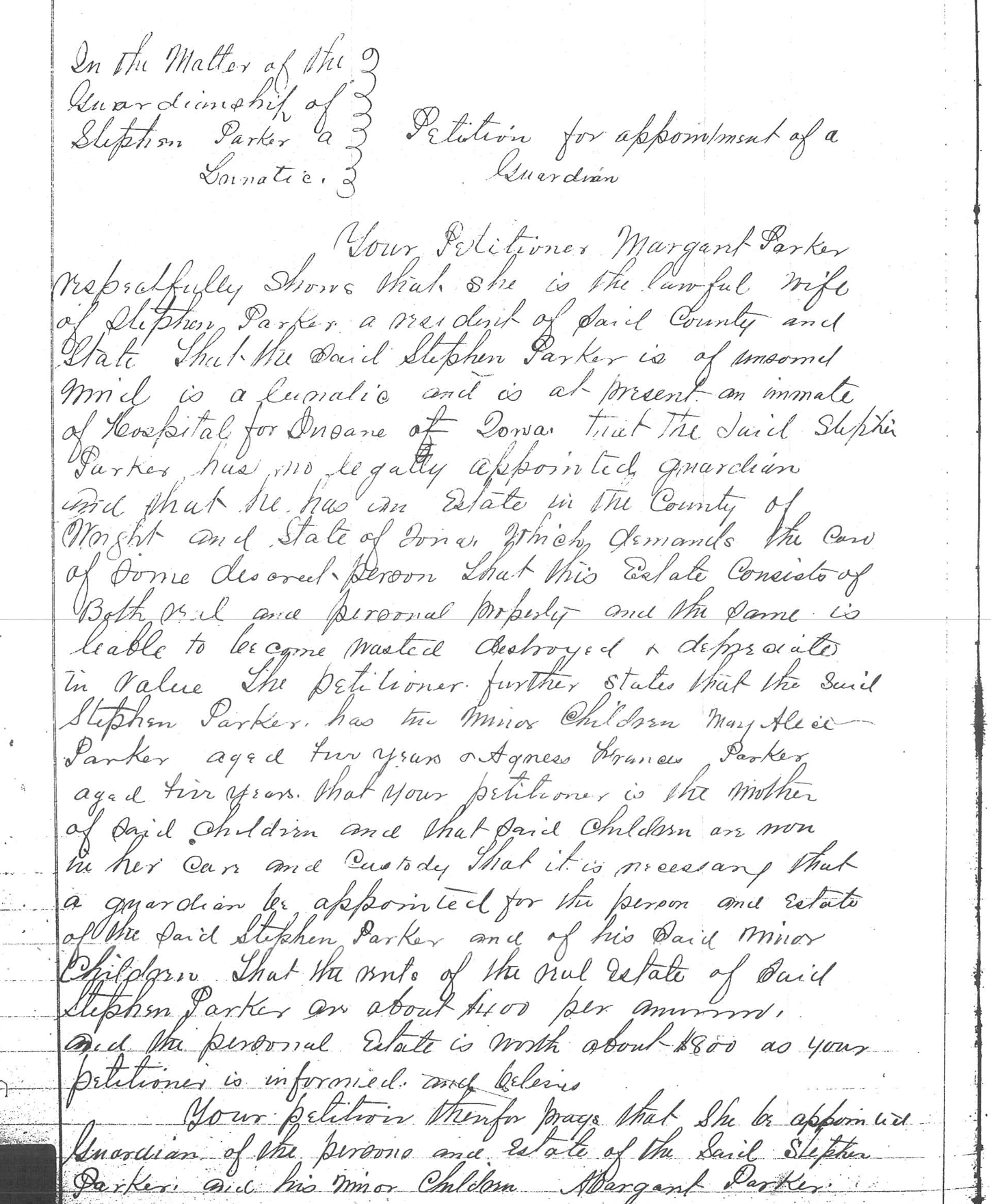
Pick a subject. At this point, I’m thinking of doing my project on either or both of my third great grandparents, Patrick Parker and Mary Murphy. (I’ve written about them on the blog before.)
Create an annotated chronology
Develop research questions, both historical and genealogical
Develop a bibliography. His overview included the following types of sources:
General books, including textbooks.
Scholarly articles (JSTOR)
Encyclopedias (he didn’t cover this one too much)
Historical books and magazines published at the time
Local histories
Historical maps
Historical photographs.
Newspapers of the time
History web sites
Sample Research Journal
Keep a research journal. He didn’t really cover what to record on this, other than keeping what he called a two-sided journal. In other words, record what you are searching and reading on one side, and notes and thoughts on the other. He didn’t really seem like he’s embraced computer technology like I do.
Tonight was the first session of my Genealogy and Family History class through the Continuing Education office at U.W. I don’t have a whole lot to report about the experience, as we did not cover any academic material today. The first half of the class the instructors reviewed the syllabus and their expectations. None of the work appears to be particularly difficult. Assignments include things like retrieving and printing a page from the census and requesting a vital record.
Wright County Iowa
The second half of the class was dedicated to student introductions. Not so much tell us a little bit about yourself as tell us a little bit about your family. Throughout the introductions, whenever someone mentioned Iowa the genealogy instructor (the other instructor focuses on history) asked what part of Iowa. She mentioned she had a lot of interest in one county. About the 4th time she asked about Iowa, I realized that her name has been ringing a bell in the back of my head, and I realized why. She runs the GenWeb site for Wright County, Iowa. As I’ve documented here, my third great grandparents Patrick Parker and Mary Murphy Parker appeared to have ended up in Iowa. Four or five of their children were in Wright County Iowa, two others in Franklin County, the next county over.
I’m being taught by a person who has expertise in the genealogy and history of a specific county I’m interested in.
I think I’ve found the correct passenger manifest which shows my great great grandfather Anton Weiss arriving in America.
Anton applied for a passport in 1886 stating that he emigrated from Bremen on 4 Mar 1852, however he forgot the ship’s name.
On 9 Apr 1852 the Agnes arrived in New York from Bremen with an Anton Weiss aboard. He’s 24 years old, from Prussia, and his occupation is mechanic. That’s doesn’t exactly match what I know about Anton Weiss, but it’s reasonably close. Anton was actually 25, from Bavaria, and worked as a tinsmith in the first references to his occupation in the U.S. Anton turned 25 on 27 Feb 1852. He could easily have been 24 when he first registered with the Bremen emigration bureau.
Anton Weiss on the Agnes passenger manifest
What clued me in to the manifest is an entry in the United States Germans to America Index, 1850-1897 for Anton Weiss. That lists a 24 year old Bavarian named Anton Weiss, occupation coppersmith, arriving in New York on the Agnes on 9 Apr 1852. I don’t know why this database lists him as Bavarian rather than Prussian or gives his occupation as coppersmith instead of mechanic. This entry matches what I know about Anton Weiss pretty closely.
Coppersmith, tinsmith, and mechanic would have been very similar occupations in the 1850s. That discrepancy doesn’t bother me.
The discrepancy that bothers me is the scanned microfilm image gives his origin as Prussian. Bavaria and Prussia were were not interchangeable countries in 1852. Indeed, several other passengers have their origin listed as Hesse, Hanover, and Germany. So where the Germans to America Index gets Bavaria, I don’t know. Stuff to research!