The whereabouts of Nels Sorenson

I think I now have a complete set of census records for my great great grandfather, Nels Hansen Sorenson. He’s part of my grandmother’s branch of the family; she was estranged from the family so everything I know I have to reconstruct from records.

Her grandfather Niels was born in Langelands Denmark to an unmarried couple, Johan Sørensen and Marthe Kirstine Nielsen. A couple years later Marthe had another child out of wedlock, though she eventually married that man.

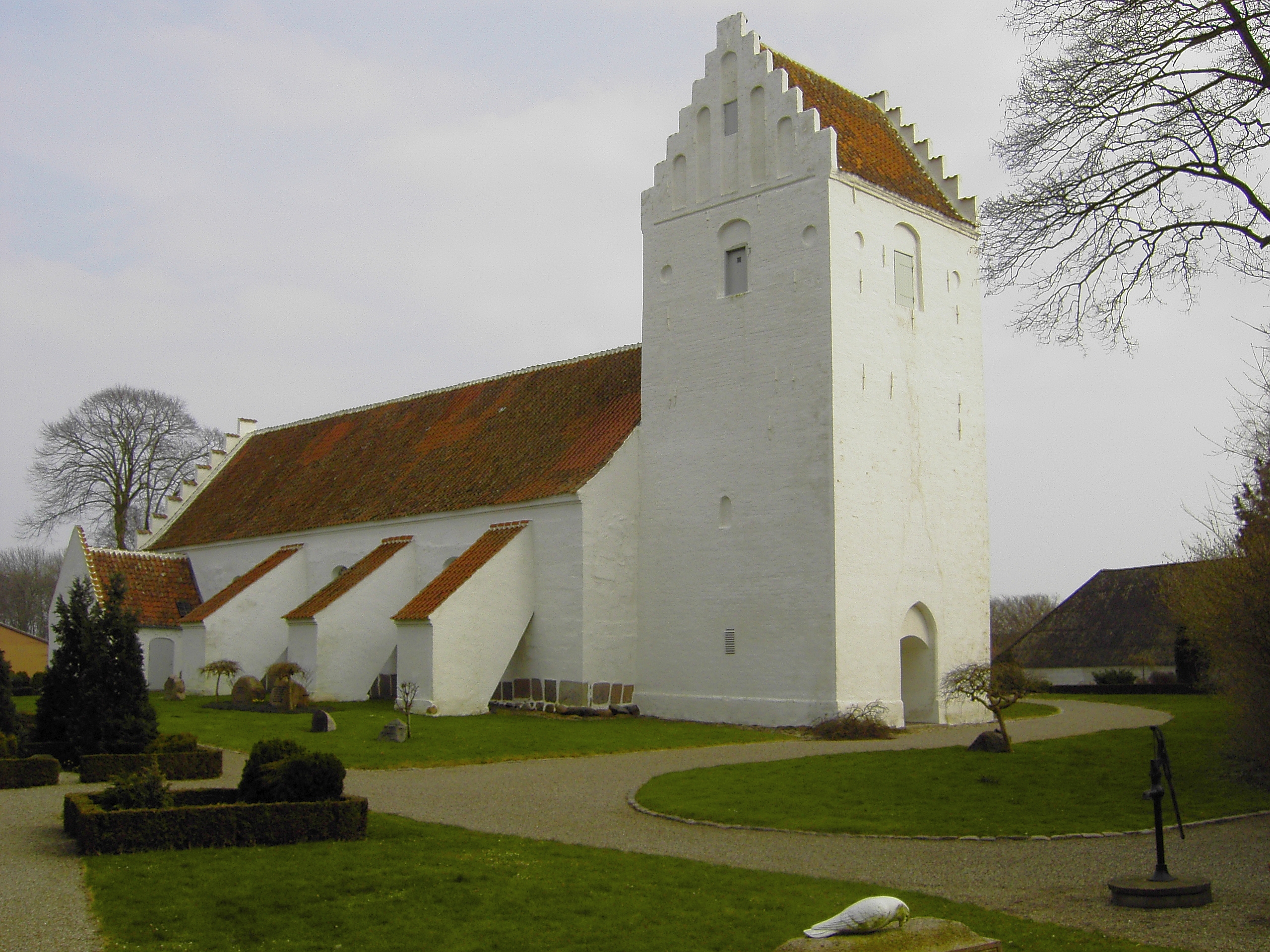
Perhaps because he was illegitimate or perhaps because his parents were poor, but Nels was not raised by his parents. He is with his mother in the 1855 Denmark Census in Bøstrup when he is about 6 months old. But in 1860 he’s living with his grandmother in Skrøbelev, and 1870 he’s a servant/farmboy for another person in the same parish who at this point I do not know if is related.

Skrøbelev Kirke
Skrøbelev Kirke (CC Arne Alexander Fræer Eckmann)

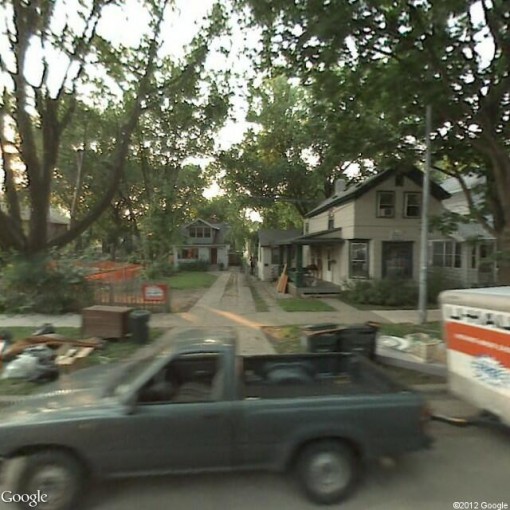
In 1880, Nels is still in Langelands in Illebølle but he’s married to my great great grandmother. In 1883 they would emigrate to Madison Wisconsin, where he Americanized his name to Nels Sorenson. In the 1900, 1910, 1920, and 1930 United States Censuses, he’s living at 1118 E Gorham Street in Madison. I’ve also got the 1905 Wisconsin State Census for him as well. He died in 1931.

1118 E Gorham Madison Wisconsin
1118 E Gorham St, Madison (Google Street View)

Assembling the Danish Census images was tough because it’s poorly indexed. I looked through them digital image by digital image. Luckily, the places he lived on Langelands are not particularly populated places. I think I only had to look through about 500 pages. Despite the use of patronymics, the name Niels Hansen Sorensen is pretty uncommon on Langelands. I’m not 100% certain the 1870 census I found is him though. The age, location, and birth place match with what he reported on other censuses, but I still don’t have a conclusive way to tie them together.

I am also missing the 1885 and 1895 Wisconsin Censuses for him. Those are theoretically well indexed, but he’s not in the indexes and Madison/Dane County are big places to search image by image. As those censuses include only the name of the head of household, I can’t search for other family members hoping that Nels himself was mis-transcribed.

Elizabeth Holler’s missing 1870 census

I love it when I find something that other researchers on Ancestry haven’t.

Spent the last couple days tracing my maternal 2nd great grandmother, Elizabeth (Holler) Hathaway. From the Hathaways of America book, I knew her birth place and date, date of marriage, and date and place of death (Seattle). Plugged those into Ancestry and started digging.

Using Ancestry’s tools I was able to easily find her census records for 1860, 1880, 1900, 1910, 1920, and 1930. For some reason, Ancestry doesn’t have her date of marriage, though it is in Wisconsin marriage registry that Ancestry has indexed. No matter though, I have other sources for that.

There are 8 other people who have her in their public trees on Ancestry. All of them have pretty much the same information I have above. But missing was the 1870 census. In the 1880 census she had a sister Nancy who was born in Illinois about 1865. There were also three nieces/nephews living with the family with last names of Curry.

I looked at older sister Susannah to see if I could find a marriage between her and anyone named Curry, but didn’t find anything promising. Then I looked at older sister Mary. There were some records of a Mary Ann Holler marrying an Isaac Newton Curry in 1869 in Shelby County, Illinois. So I jumped over to FamilySearch and looked at the 1865 Illinois census and found a George Holler living in Ash Grove Township in Shelby County. But that census is one of those where only the head of household is recorded, so I don’t know for certain if it’s the correct George Holler.

Holler family in Illinois for 1870 census

Jumped back to Ancestry and pulled up the 1870 Census for Ash Grove, and start paging through images, 38 in all. On sheet 30, I found a George Holler living with Mrs Holler, George Jr, John F., Mary A., Elizabeth, Matilda, and Nancy. The names match up with the Holler family in the 1860 and 1880 censuses. I suspect Ancestry couldn’t find it because the first name of George’s wife wasn’t recorded and the family name was speller Haller. Seems like the Soundex matching doesn’t match Haller and Holler. (This census record conflicts with Mary being the spouse of Isaac Curry, but it definitely is the right family.)

Now I have as complete of a census record as I’m going to get for my great great grandmother.

Citations to “America’s Obituaries”

I’m making an effort to update all my citations to something more comprehensive than my previous notes. They’re sufficient for me to find items, but probably not enough for other people. My current dilemma is how to cite obituaries listed in America’s Obituaries that’s part of the GenealogyBank service available through the Seattle Public Library. Unfortunately, I can’t find anything directly on point in Elizabeth Shown Mills’ Evidence Explained.

When a service has scanned images of a newspaper, I’ve been citing the article at the newspaper, available at the service. For example, article X from the Capital Times, date D, page Y, accessed at NewspaperArchive.com at URL, blah blah blah. GenealogyBank offers a similar service.

But the America’s Obituaries database is transcriptions rather than images, with a citation to the newspaper and day of publication. It does not always include the page number. As best I can tell, I should be citing the America’s Obituaries database with a notation that they cite a source. That’s because in this case I don’t trust the service to provide a 100% accurate transcription. There are other obituary aggregation services that I’m even less sure of.

There are additional complications. The database is made available through the Seattle Public Library. The database name is sometimes different when offered through other providers. For instance, if I bought a subscription to GenealogyBank on my own, they call it simply Newspaper Obituaries. And possibly the content of the database is different when accessed through different portals. So do I cite GenealogyBank or the Seattle Public Library. I should probably have both there somewhere, but I can’t find anything in EE that addresses this. It talks about citing the publisher of the database, but not the portal.

The following is what I have for an obit that cites a specific page, but I haven’t quite figured out how shoehorn the Seattle Public Library in there, though it sorta shows up in the URL.

America’s Obituaries, online database, GenealogyBank (http://infoweb.newsbank.com.ezproxy.spl.org:2048/gbnl/obituaries/ : accessed 3 Aug 2012), “Edward bender”, obituary, 7 Apr 2000; citing The Bismarck Tribune (Bismarck, North Dakota), 7 Apr 2000, page 13A.

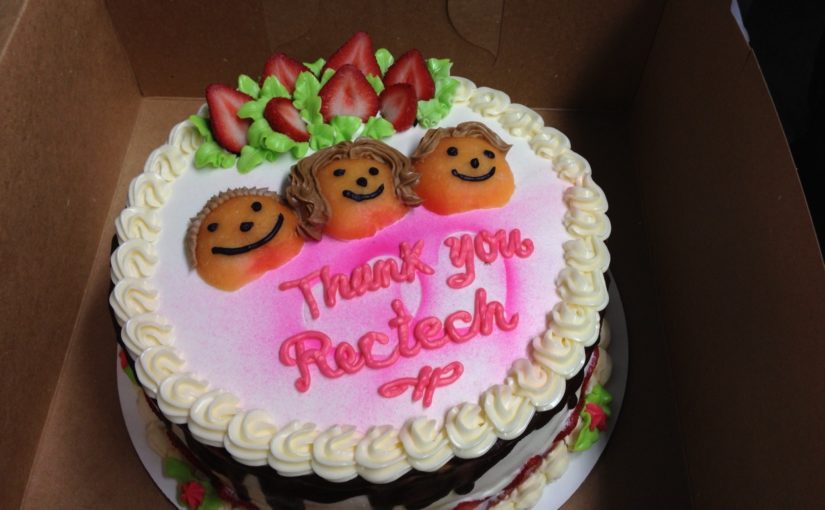
Amazing Cake!

Amazing Cake

I apologize for posting this all over my social footprint today. However, this cake is just too amazing to not share pretty much everywhere. Today was the last day for my summer teaching gig. One of the students made this and brought it in for the class to enjoy.

The young man who made this is in high school. I couldn’t make macaroni and cheese from a box in high school.

Don’t Do This

Bandwidth graph for 4 hours

I have purposefully left my wifi open and free to use for anyone close enough to do so. If you are in my building, look for the SSID ApproveRef74. No password, and for the most part, no restrictions.

Today I realized someone in the building has been running a server off my wifi and has been maxing out my upload bandwidth. I don’t know who, but his name is James. Or at least I assume so because his computer was named JAMES-PC. That computer is now banned from my network.

If you look at the graph, the green is me watching a very high quality video feed. No, not porn. A soccer match between DC United and Philadelphia Union. The blue is the dipshit who owns JAMES-PC transmitting nearly as much data as I was watching. Way to take advantage of my hospitality.

Since I can’t send a message to James, I’m leaving this out there in case he googles himself or the SSID or something. When someone offers free wifi, don’t make it unusable. Now you have to buy your own wifi. If you aren’t James and you are doing this to someone else’s wifi, stop.

A slight connection to Lawrence Welk

My step-father grew up in Emmons county, North Dakota. His grandmother was Katherine Feist from Strasburg. I’ve vaguely known that Strasburg was also the home of Lawrence Welk, but I hadn’t really thought about it that much. Today I ran across a map from 1916 that shows where her farm was. It’s marked in red in the map. Each big square on the map is one mile on each side. The Feist farm is a half-mile square.

About a mile and a half to the west is one farm owned by Ludwig Welk, Lawrence Wel’s father. And about 3 miles to the north is another owned by the Welks. Both are marked in green. The Lawrence Welk birthplace is just north of Strasburg, which is not either of the two properties.

I couldn’t tell you which of them actually had the family homes, nor do I know the exact time frame for the map. It was published in 1916, when Lawrence Welk was 10, and Katie Feist had married and moved away 2 years before. But another page of the atlas has a different relative owning property that I’m told he lost in 1911 or 1912, so there was quite possibly a few years lag from when the people listed as owning the farms actually owned them. The 1900 census has the Feists in Strasburg, but by the 1910 census they are in a township called Marie, which is quite a way away. So it appears the maps are quite a bit out of date when published in 1916.

Anyhow, for a couple of years, they were fairly close.

Map showing locations of the Ludwig Welk and Joseph Feist farms

William Solle’s incongruent age of first marriage

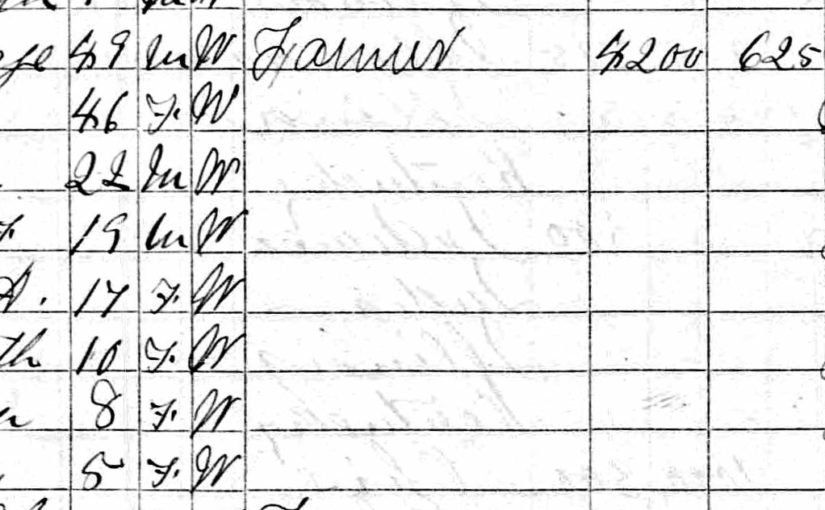
I just noticed something interesting today. The 1930 US Census asked people at what age they first got married. Here are the answers for my great grandfather William Solle and great grandmother Flora Sorenson Solle:

Entries for William and Flora Solle in the 1930 US Census

William and Flora got married in 1910, which is verified by their marriage certificate. In 1930, Flora was 42 and first got married at age 22. That matches up with the date of her marriage to William in 1910. However, William is 65 and first got married at age 42. That works out to be 1907, which is not when he married Flora.

Census information isn’t particularly accurate or exact. However, that’s intriguing enough that I now am going to start looking for possible records of an earlier marriage. I may have additional relatives I didn’t know about.

Death and taxes

Got the call from the accountant this morning. They’ve got all the taxes figured out and the forms ready for me. This includes for my mom’s estate, the trust, and for my dad.

Once those are sent in, I can close the estate.

It will happen before the 4 year anniversary of mom’s death.

More phone banking

Thursday I participated in my third week of phone banking for Referendum 74. It was a very odd session.

My own dialer session called 141 people, but I actually had only 3 conversations with people and none of them were undecided. They were all strongly for marriage equality. With those folks, all we generally do is remind them that a vote to approve Referendum 74 is a vote for marriage equality. But not only were there no undecided people, there were no anti-marriage equality people. I had a lot of hang-ups, refused to answer, not homes, and wrong numbers. I think I had 3 people who were angry we had called them. Don’t you know my number is on the Do not call list? asked one lady. Nope, I don’t. See, lady, political calls don’t have to scrub people based on the do not call register. There’s this little thing called the First Amendment. Of course, I don’t tell them that or argue with them. I simply just ask Would you like me to put you on our do not call list? and then I do. Anyway, bummer about not talking with any undecided voters.

I also spent some time training a fellow next to me. He really had a hard time with it. In the role play before we started calling, I played an undecided callee. He really wanted to convince my character that marriage equality is a matter of civil rights and started to veer into trying to argue my character into voting for marriage equality. Which isn’t what we are trying to do. The phone bank script emphasizes the personal and emotional benefits of marriage for gays and lesbians. Rather than talk about fairness in hospital visitation rights, we’re supposed to talk about how visitation means a gay/lesbian family member gets to visit their loved one. It’s sometimes a subtle but important distinction. People sometimes think domestic partnerships are fair, for instance. We’ll tell them that no one dreams of a domestic partnership document signing, they dream of a wedding. The point, I think, is to make it personal and real. Even the prejudiced people, for the most part, don’t hate gays. They fear them, and we’re trying to make gay marriage just a bit less scary.

Anyway, dude to the left of me kept slipping into arguing. He also got off script early on too. Rather than tell people we’d like to talk with them about the freedom to marry, as the script notes, he started telling people we’d just like to ask a quick question about Referendum 74. Which doesn’t get the idea of the freedom to marry or even marriage equality burbling in callees’ heads at the beginning. Talking about a referendum tends to close off discussions before they start. And second, if they are leaning against, it’s gonna make them feel lied to when we do want to talk more than a quick question. Liked the kid, but he was making things hard for himself.

I won’t be doing the phone bank this week though. There’s a Sounders match on Thursday night. However, I’ll be participating in a training session on Wednesday so they can have me run future phone bank sessions. We’ll see how those go. I’m surprisingly good on the phone. I found this out when calling people on behalf of Ron Sims in 2004. I don’t know how good I’ll be at helping people do this though. As I’ve found out this summer, I’m not exactly a natural teacher.

Phone banking for Referendum 74

For the last two weeks I’ve spent 3 hours on Thursdays phone banking in support of Referendum 74. Washington United for Marriage has been running a pretty organized campaign to make sure marriage equality passes. They are doing phone banks at least 4 days a week. They’ve run some demographics to identify likely undecided voters. And then we call them. Find out what their concerns are about letting gay and lesbian people get married. Try to allay those concerns. Talk to them about how much marriage might mean to gay and lesbian families. It’s all persuasion rather than arguing.

My phone bank equipment has dialed almost 400 people in those 6 hours, and I’ve had about 35 actual conversations with people. We get a lot of people who don’t want to talk, and a lot of answering machines and wrong numbers and calls that just don’t connect. And out of those 35 conversations I maybe have nudged 2 people a bit more toward supporting Referendum 74. Just having the conversation that isn’t an argument gets most of them thinking about it in a way they haven’t previously. In the end, if we get only 1,000 people to support it who otherwise would have voted against it, that might be all the difference we need.

I kinda sorta think Referendum 74 will pass pretty easily, but that may just be optimism. I strongly support it, and live in an area where most everyone else also strongly supports it. I’m in a bubble that likely is inducing wishful thinking. But I kinda know that, so I’m working to get this thing passed anyway, just in case I am wrong.

Which reminds me, do you want to help out? Even if you only do one phone bank, that’s 20 people who have a conversation about marriage that won’t otherwise have that conversation. I’ll make you a pie or buy you a beer if you help out.