King (then Prince) Abdullah of Jordan appears in a 1996 episode of Star Trek: Voyager
A few days ago N.P.R. news analyst appeared on Fox News where he commented that he worries whenever he sees Muslims:
when I get on the plane, I got to tell you, if I see people who are in Muslim garb and I think, you know, they are identifying themselves first and foremost as Muslims, I get worried. I get nervous.
– NPR Ends Williams’ Contract After Muslim Remarks
As noted by the story title, N.P.R. let Williams go after he made those remarks. There’s been a hue (sp?) and cry over this firing, many considering it unfair. As stated by N.P.R., Williams’ contract with N.P.R. requires him to adhere to N.P.R.’s policy on speaking even when he speaks elsewhere. He’s not allowed to do partisan speeches, for instance. N.P.R. wouldn’t approve of expressing irrational fear of Muslims on their network, so he’s not allowed to do it on Fox News either. So they fired him.
Juan Williams has a long history of going beyond what he’s allowed to do by his contract. This is important in my assessment.
I think it’s legitimate to argue that the punishment did not fit the crime. I disagree. But it’s a legitimate argument. Because of his long history of violating N.P.R. policy, this incident is a last straw situation. It’s unfortunate that Juan Williams lost a platform to speak (it is a form of censorship), but I think it is entirely within N.P.R.’s prerogatives.
In the end, Juan Williams suffers very little harm from it anyway, which is unfortunate. He immediately received a $3 million deal from Fox News, so he’s hardly getting screwed over.
One (of many) of the irrational beliefs Juan Williams holds is that someone can tell what a Muslim looks like by his/her Muslim garb. I think you’d be surprised. Muslim women do not all wear burkas. Muslim men do not all wear robes or beards. An anonymous (so far as I know) blogger started a new blog today that is simply titled Pictures of Muslims Wearing Things. It aims to post pictures of Muslims wearing all sorts of clothes. Now perhaps you will look at it and think, Well obviously that’s a Muslim, I can tell. But I think most people will be surprised by how they look. Muslim garb is hardly what people think.
Initiative Measure No. 1107 concerns reversing certain 2010 amendments to state tax laws. The measure would end sales tax on candy; end temporary sales tax on some bottled water; end temporary excise taxes on carbonated beverages; and reduce tax rates for certain food processors.
I’m in favor of sin taxes if I agree that the items being taxed are sins. It’s simple economics: tax the things you don’t want to happen. When the price goes up, people do them less. It’s the principle behind cap-and-trade and carbon taxes. It’s the principle behind congestion tolls. It’s possible to raise such taxes too high. When a thriving black market in the item comes around, then you know the taxes are too high.
I’m all for taxing candy and soft drinks. There exist relatively cheap, relatively healthier alternatives that people can buy instead, if they want to avoid the tax. If you can’t go without your Coke Zero, pony up.
The soft drink industry has spent something like $16 million to pass this. The advertising campaign says it’s all about the taxes on grocery items that were included in the tax for technical reasons. a) the taxes on those items are around $4 million. The beverage industry could have donated the $16 million to grocery manufacturers 4 times over, and we wouldn’t have a need for the initiative (if even that’s a concern). b) The opponents of the tax could have crafted the initiative to repeal just the grocery tax part, but they did not. Their arguments hold little weight with me because of this.
Initiative Measure No. 1100 concerns liquor (beer, wine and spirits). The measure would close state liquor stores; authorize sale, distribution, and importation of spirits by private parties; and repeal certain requirements that govern the business operations of beer and wine distributers and producers.
Initiative Measure No. 1105 concerns liquor (beer, wine and spirits). The measure would close all state liquor stores and license private parties to sell or distribute spirits. It would revise laws concerning regulation, taxation and government revenues from distribution and sale of spirits.
The state government should not be operating private retail stores absent some important reason. The fact that Washington State does is (I assume) a vestige of the repeal of Prohibition, combined with a large amount of inertia. It does make getting liquor for minors somewhat more difficult, but not exactly because security at these stores is tight. They do have a better record at refusing sales to minors. But I think the real reason state liquor stores do better is that they aren’t so busy and there aren’t too many of them. The stores have a high markup, and limited selection. As some bars have noted, they cannot get some liquors for their businesses and service is not good.
There are two initiatives on the ballot that would get the state out of the liquor selling business. If both pass, how things will shake out will be anyone’s guess.
I-1100 is the Costco sponsored initiative. It removes a lot of the regulation on liquor sales as well as getting the state out of it. Places that have a license to sell beer and wine could get a liquor sales license, and the state would be limited in what it could regulate with regards to liquor sales. The key part for Costco is that it eliminates the current three tier system: manufacturer, distributor and retailer. As a retailer, they could skip the distributor and go straight to the manufacturer. The measure retains the current taxes on liquor.
I-1105 requires the state to close its stores, but retains more of the regulatory framework. The three-tier system would remain in place. Retailers must by from distributors. And distributors cannot offer better prices to one customer that to another, though they could offer volume discounts. Costco doesn’t like it, because they would like to negotiate lower prices directly from manufacturers that aren’t available to other retailers. The WSLCB would create a new license for retailers and establish the rules for it. For instance, they refrain from issuing new licenses in areas that are saturated with liquor sellers. The measure would remove most taxes on liquor sales (not sure about sales taxes) and direct the WSLCB to propose a new tax to the legislature.
I will be voting for I-1105 and against I-1100. While I think anti-drinking goes too far sometimes (like freaking out over restaurants that allow patrons to drink in their sidewalk seating), the fact that liquor is intoxicating means we should be exercising some discretion in how we sell it. I-1100 doesn’t allow for that. For instance, I-1105 could allow the WSLCB to require that liquor be sold in separated areas from other goods, while I-1100 does not. I’m not so keen on the requirement for three tiers, though I do like the requirement that distributors offer uniform prices. I’m agnostic toward the tax change. It comes down to the ability to regulate liquor retailers.
Initiative Measure No. 1098 concerns establishing a state income tax and reducing other taxes. The measure would tax “adjusted gross income” above $200,000 (individuals) and $400,000 (joint-filers), reduce state property tax levies, reduce certain business and occupation taxes, and direct any increased revenues to education and health.
This one is another easy one for me. Washington has one of the most regressive tax structures in the country, because it relies heavily on the business and occupation tax, and the sales tax. Both of those taxes make low income folks pay a larger percentage of their income in taxes than higher earners. The B&O tax because it gets passed on in prices, though a fair amount of it is non-consumer goods. As people make more money, the marginal sales tax rate with respect to a person’s income falls because consumption falls off at higher incomes. Money moves from consumption to investment. To explain, if you are broke, the next $5 you get will be spent on food (or gas, or whatever). If you made $1,000,000 last year, the next $5 will much more likely be used to buy stocks (or bonds or whatever). The sales tax on the poor person’s $5 is going to be approximately 50¢ where the sales tax on the rich person’s $5 will be close to zero. The choice to not spend is constrained the poorer one is.
We also rely heavily on a property tax, but that also gets passed on to anyone who lives in the state. It’s either direct, or paid out in higher rent. I don’t think property taxes are as regressive as the sales tax, but they are still regressive.
I1098 establishes a high earners income tax for the state, while cutting a portion of property taxes and B&O taxes. Income taxes can sometimes be regressive, but they are easier to structure to avoid it. In this case, it’s very progressive. People who need the next $5 to eat won’t get taxed. People who invest it in stock will. For that reason alone I am for it.
I also think it will help stabilize the state’s revenue somewhat. Not completely, but a bit. Aggregate income is a better gauge of the state’s economic activity than consumption. Consumption can only drop so low, and it can only climb so high. It allows the state to skim off the income in good years for the bad. We currently do that with sales taxes, to some degree.
The only arguments I’ve seen against it are hysterical rantings. The legislature will extend it to other people in 2 years!! Yup. They could. They could establish an income tax and extend it right now. This changes nothing with regard to what the legislature could do. And it changes nothing as far as people’s ability to oppose it. If people are against increasing the tax, and the voters don’t want it, they’ll vote them out. Or have a referendum against the law.
I’ve also seen but I’m not rich even though I made nearly $2,000,000 last year. And even no one I know who makes $200,000 is rich. It’s not fair to MEEEEE! Here’s something to think about: SHUT THE FUCK UP! You are rich. This is not the end of the world. You can better afford this than someone making $20,000. They’ve been sucking it up for years. Now you’ll have to for a bit.
By the way, in case you were wondering, these opinion piece aren’t really intended to convince people. These are polemics which explain my reasoning for voting for them. I fully realize telling a rich person to STFU isn’t going to convince them to vote for this.
Been wanting to move the book web site to a couple new domains, and revamp the design. I am paying someone to do the graphic design part of it. Just got the first set of mockups for one part of it. Hot damn! Really liking what she’s done. Dunno how long it’s going to be before I launch this thing, but this part is going to be good.
Been feeling a little shut in lately. A few things in the last few years have reduced the amount I’m prodded to get out, so I have to prod myself. And I’m not particularly good at that.
Made myself go out dancing last night. I didn’t stay out long, nor did I feel socially comfortable enough to chat with anyone I didn’t know, but it was a start.
Earlier yesterday, I helped Kim move, and then stayed at her place for a while afterward and played a game with fellow movers while Kim unpacked. Kim’s roommate Ian picked up Killer Bunnies at a convention, and some folks had heard good things about it, so we played that. We were actually playing with a bunch of the expansion packs too though. The game ended up being boring, but the company was great.
Today I decided to go to Emily’s regular Sunday game event at Captain Black’s. Met a few nice people in addition to Cody and Emily who I already knew. We played one game of Burn Rate while we waited for everyone to arrive. I vaguely remember having played it before. I got some lucky cards at the beginning. It felt like I won because of luck rather than strategy.
Then we played Dominion. We had enough players to play two separate games, so we did. The web site says it’s supposed to take about 30 minutes. Our three person game took a couple of hours. Winning strategies weren’t apparent early on, so I kind of floundered for a bit. Still took second, though I was way behind the winner (71 to 34).
Initiative Measure No. 1082 concerns industrial insurance. The measure would authorize employers to purchase private industrial insurance beginning July 1, 2012; direct the legislature to enact conforming legislation by March 1, 2012; and eliminate the worker-paid share of medical-benefit premiums.
My opinion on this one won’t be as long as I-1053. I’m all for having private workman’s comp insurance options, but I don’t think this initiative is the way to do it. My concern is with who wrote this: the Building Industry Association of Washington. The No on I-1082 campaign has a detailed list of the problems they see in the fine print of the initiative. Their take is that the fine print will leave workers on the hook for job related health problems (injuries, occupational illnesses, etc.) for businesses that choose to go this route.
I’m not a lawyer. I can’t parse through all the fine print and compare it to existing law, regulations, and court cases to see where it falls down. I don’t exactly believe the F.U.D. pushed by the no campaign either. I have read the detailed text of the initiative though, and it’s certainly not a clean easy to understand bill. While those issues may not be nefarious, they could be, and I don’t have a good way to tell. If it were the product of negotiation in the legislature, I’d be in favor. But it’s not.
I-1082 is the product of a conservative business organization that’s known for looking out for it’s interests instead of the general public. If you look at the list of organizations endorsing the initiative on the Yes on I-1082 web site, every single one of them is a business interest. Their argument is that if they can get cheaper insurance, they’ll hire more people. I really don’t think that’s the case. They’ll take the difference and put it into their profits (or maybe lower prices if the particular industry is extra competitive). You don’t pay more for one ingredient because you pay less for another. They’ll increase wages only if the demand for labor increases relative to the supply, and this doesn’t change that ratio at all. I just don’t see this as a net win for workers.
So I’ll vote against I-1082. If called on to vote on a version created by the legislature, I’d vote for that.
I totally forgot about this yesterday. As I get older, I remember these things in the day before the anniversaries, but forget the day of. Same thing this year, even though it’s a big year.
Twenty years and two days ago, I called a suicide prevention line to get my drinking under control. Wasn’t suicidal, but didn’t want to wait for my nerve to fail in the morning to call around for help, and the only number my drunken self could think to look up in the phone book was the 24 hour suicide prevention line. Didn’t intend to quit. Just get it under control, so my grades would improve. (They didn’t.)
Nothing particularly important to say about it other than, hell that’s a long time to not drink.
A few of my friends have asked if I planned to write about my opinions on the upcoming election, particularly regarding the initiatives on the ballot. I love spouting off my opinion, so here I go! Of course, I want to point out to my 3 or 4 readers that none of what I write is particularly original. You can probably find much better argumentation elsewhere on the internet.
Initiative 1053 concerns tax and fee increases imposed by state government. The measure would restate existing statutory requirements that legislative actions raising taxes must be approved by two-thirds legislative majorities or receive voter approval, and that new or increased fees require majority legislative approval.
This is a Tim Eyman measure. That alone almost tells you how I will vote on it. The only Eyman measure I’ve ever voted for was the one that instituted performance audits.
Several previous Eyman measures passed that duplicate what this measure does. But the state legislature has suspended the rules instituted by those initiatives in order to pass budgets. How does that work? According to the Washington state constitution, Article II, Section 1(c), after two years the legislature may do what it wants with any initiative. During the two years, changing an initiative requires a 2/3 vote of the legislature. It’s been more than two years, so they suspended it. This initiative basically unsuspends it for another two years. (The legislature did not overturn the law, just suspended it.)
Well, as you can guess, this royally pissed off the Eyman crowd, and that’s why they have this initiative.
My view is that a supermajority should only be required for extra-ordinary circumstances, things that don’t happen too often: changing the state constitution, declaring war, suspending civil rights, expelling a legislator. A supermajority means that a minority of people can prevent action. That’s appropriate to prevent civil rights from being abrogated. It’s appropriate to keep a power from being unchecked. But for mundane things, it’s inappropriate to require a consensus. It checks power too much. We already have mundane checks on power for mundane things: voting out legislators, separate bodies of the legislature, gubernatorial vetoes, the court system, referendum, and probably lots more that I haven’t thought of.
There’s nothing more mundane for the legislature about running government than determining the budget, taxes, and spending. Holding the running of the government hostage to a minority is bad business. As much as I object to funding abstinence only sex education, for instance, I don’t think a liberal minority should hold that up. (Luckily, that doesn’t seem to be the case recently.) I have the option of voting for a different candidate, for collecting petitions on a referendum, or having a sympathetic governor veto it (or line-item veto it).
I have another philosophical problem with this initiative, like the previous versions of it: it attacks a made up problem. Washington state does not have out of control taxation. I-1053 proponents would have you believe that the legislature can’t prioritize and so it just increases taxes to fund everything it wants. But that’s not the case. The Great Recession reduced the state’s revenues by billions. From I-1053 proponents, you’d think the legislature’s response was to raise taxes and fund all previous programs. We faced a reduction of revenue to the tune of about $2.8 billion for the current budget. The legislature raised about $780 million in taxes. The state received another $1.4 billion from other sources, such as the federal government and the rainy day fund. It cut about $714 million from the budget. I certainly think people can legitimately argue that there should have been more cuts. What is ludicrous is the idea that government just taxes and spends.
The approach is wrong. Don’t just say the legislature has it’s priorities wrong. Tell them exactly how it’s wrong. Get signatures on an initiative that eliminates programs you think are wasteful. (Initiatives can’t actually budget though. That does make things more difficult for this method.) I almost never see people who say the state taxes too much actually propose specific programs that should be cut. They instead rail about wasteful spending. But they never want to do the hard work of finding the wasteful spending. That’s the legislature’s job, according to them. Which it is, but it is also their job as citizens, voters, and human beings to give the legislature guidance. The few times I see suggestions of actual cuts, they are unrealistic for various reasons. Eliminating welfare completely. Or the cuts don’t come close to adding up to what’s needed to cut spending by the amount they want.
The reality is that the state tax burden is declining. That’s the evidence from the conservative Tax Foundation. In 1994, the state had an effective tax rate of 10.4% ranking it 17th among states. In 2008, the effective rate was 8.4%, ranking us 35th. Those numbers include both state and local taxes. At the state level only, the number of employees dropped over 4% from 2008 to 2009. Over the longer term, the state hasn’t exactly grown hugely in employees. According to the U.S. Census, the state had 133,000 employees in 1997, 149,000 in 2002, and 153,000 in 2007. That’s about a 15% growth in employees over 10 years, and before recent cutbacks. Over that same time period, the state’s population grew 13.6%. State government got a little but larger than our population would indicate, but not by much. Wages and salaries for state employees over that time went from $307 million per month in 1997, to $411 million in 2002 and $504 million in 2007. That seems like a huge increase, until you adjust for inflation. That $307 million in 1997 is worth $397 million in 2007, and the $411 million from 2002 is $473 million in 2007. Inflation adjusted, that’s a 26% increase from 1997 to 2007, but only a 6% increase from 2002. Compare that to the 6.5% increase in population from 2002 to 2007. Our gross state product (a measure of the size of the economy) grew 34% from 1997 to 2007. In other words, the state government isn’t growing like metastasized cancer. It’s grown, but not in uncontrollable ways. It’s growth our current tools for managing our government already can deal with.
To sum up, philosophically I-1053 is the wrong approach. Practically, I-1053 tries solve a problem that doesn’t exist to the level it’s proponents claim it does. That’s even if you think growing spending is a problem at all. I don’t. I think the legislature is already doing a halfway decent job at overall budgeting.
Data was pulled from generally reliable sources but percentages and other calculations when not explicitly supplied were done on the back of a napkin. Go dig up the data yourself if you don’t trust my numbers.
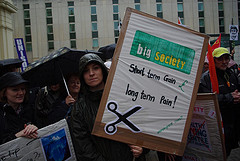
Stop the cuts / Photo by Tom Wills used under CC BY-NC license
Photo by Fibonacci Blue used under a Creative Commons Attribution license.
Tonight my cousin Dave (who is showing me around DC), suggested we go to Zaytinya. It’s an “in” place right now, owned by José Andrés who is a famous chef according to Dave. They server eastern Mediterranean food tapas style, and Dave claimed the people watching would be good. Little did we know.
We walked up, and there were two security guys outside wanding people who went in. They told us there was a special event there. We thought we were about to be turned away because Angelina Jolie (or some A-lister) was having a private party. But they just wanded us and sent us in. We got on the list for a table and chatted in the bar. Normal conversation, but Dave and I kept turning back to who might be there. There was another security guy at the base of the stairs to the balcony section. We decided it wasn’t the President because we thought the security would be much tighter, and in my (completely wrong) opinion, the security guys looked too friendly to be Secret Service. I figured some minor foreign royalty, Kofi Annan, Gary Payton type of person. Dave did ask what I thought I would do if it was the President since I’m of the disappointed in the President liberal persuasion. But we continued to dismiss that it was the President.
We got seated, ordered, and started eating. We ordered lamb in filo, asparagus, shrimp, mushroom, and veal sweetmeats tapas. I’d never had sweetmeats from a cow before. I don’t think I will order it again. It’s definitely sweet, and something between the consistency (they were supposed to be fried crispy, but weren’t) and kind of a weird taste that was released after the first bite, I didn’t like it too much. I don’t think it was Zaytinya’s cooking.
Then I heard a bit of clapping from the other side of the Zaytinya. I looked over and the entourage had already descended the stairs and were making their way toward us. We were seated the closest to the hostess station and the entrance. I didn’t recognize the woman walking toward us. Then I saw past her and the second woman was Michelle Obama!
I am not a celebrity gawker, but I’ll squee for Michelle Obama. Prior to being First Lady, she was no slouch in her advocacy and political work. She impresses the hell out of me.
The two women and the Secret Service detail made their way right by us, and only after they walked out the door did I think to pull out my phone to snap a picture. Too late by then. Ms. Obama seemed a little awkward with the scattered applause as she passed. Not put off or embarrassed exactly, but not ignoring it either. My best guess is that she was just out for dinner with a friend, but Dave suggested it might have been her mother. Possibly could be now that I’ve checked photos of her mother online, but I couldn’t be sure.
Dave was right. The food was excellent, and the people watching was superb!