I read Thomas Ricks’ Fiasco earlier this year. That was all about the invasion and bungling of the war in Iraq. He has a new book out, The Gamble, about the surge. Despite being frustrated by the book, I thought it was illuminating. I may pick up The Gamble because I don’t think I’ve got nearly the same coverage of information on the surge as I did on earlier efforts in Iraq. I haven’t decided yet.
I did take the opportunity to attend a speaking event he did at the Seattle Public Library on Thursday. It’s kind of the 20 minute version of his book. Here’s the points I took away from it (some of these came from the Q&A):
Ricks sees Obama’s approach as somewhat similar to Bush’s, pre-surge days. At the time, Bush’s policy was to turn as much stuff over to the Iraqis and get the hell out. They weren’t ready, and the things we did were counter-productive. Obama’s policy is to get out by middle of next year. Which means we’d have to turn as much stuff over to the Iraqis as possible and get the hell out. It could be doomed to as much failure as Bush’s attempt.
There’s no good options anymore. It’s trying to figure out the least bad option.
The surge failed. Security is better, but there’s been no political compromise. The point was to improve security so political compromise could be made.
Shiites believe they won, so they don’t want to compromise. Sunnis believe they are linked to Sunnis in the region and so should have more clout. Kurds will attempt to be as separate as possible de facto, no matter the result. None have any proclivity to compromise.
He sees Pakistan as the real danger. Iraq won’t be solved, but they don’t have the infrastructure to be dangerous. Afghanistan might be solved, and they don’t have the infrastructure either. Pakistan might fall apart, and they have nuclear weapons.
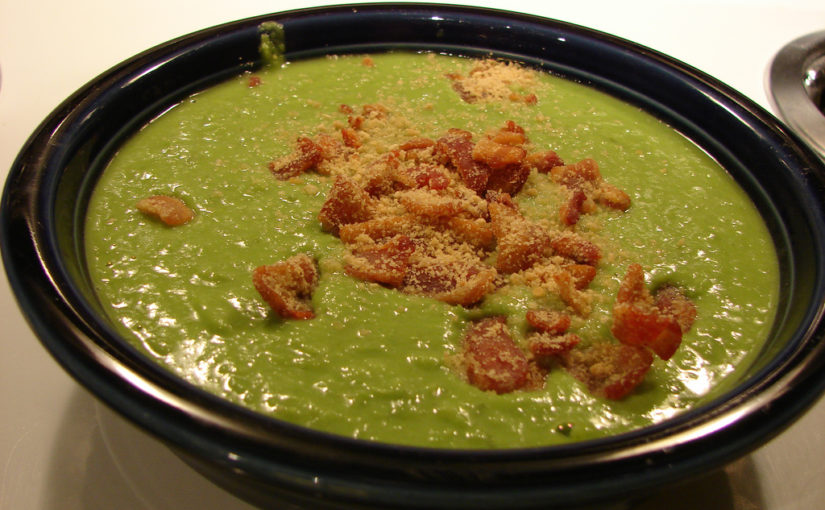
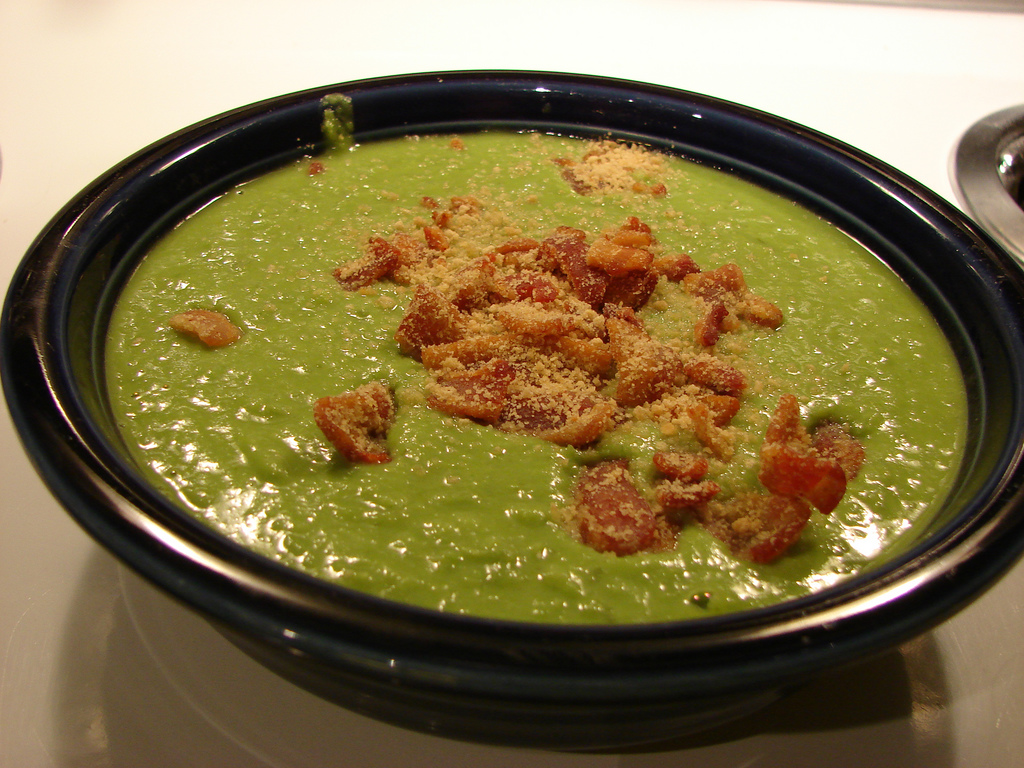
I’ve attempted a green pea soup once before. It was decent, but was missing something. Yesterday I tried out the pea soup recipe in Greg Atkinson’s West Coast Cooking.
As always, what I did is somewhat adapted from the cookbook. If you want the official recipe, buy the book.
½ stick unsalted butter
1 medium onion
1 head iceberg lettuce
2+ cups chicken broth
1½ pounds frozen green peas
6 ounces bacon
½ cup breadcrumbs
Cut bacon into small pieces
Fry bacon until crispy
Drain fat and dampen bacon on a paper towel
Mix bacon and breadcrumbs
Peel and thinly slice onion
Wash and shred lettuce
Heat butter in large soup pot over medium high heat
Cook the onion until tender
Add lettuce
Cook just until wilted
Add chicken broth
Wait for boiling
Add peas
Cook about 10 to 15 minutes until peas are tender
Purée soup in blender a couple cupfuls at a time
Salt and pepper soup to taste
Sprinkle breadcrumb/bacon stuff on top of served soup
This time the soup was pretty tasty. I think the addition of onion and bacon helped quite a bit. I don’t remember exactly what was in the last recipe, but I’m pretty sure those weren’t in it.
One area that frequently comes up is free trade. Libertarian and market-religion economists love to push free trade over all. I’m generally a fan of free trade, but one argument in favor of it bothers me: free trade improves everyone’s wealth/income/economic standing. This is not true. A better phrasing is that free trade improves a nation’s net wealth. But within the nation, some individuals will become net winners and some will be net losers. Under free trade over the long run, the gains from the net winners will be more than the losses for the net losers. But there will be net losers, particularly in the short run.
To illustrate, I shall pick a commodity. I’ll call the commodity airplanes. We might have one maker of planes in the country. For this illustration I’ll call that manufacturer Boeing, and I’m going to assume it has one owner. We might have one manufacturer because of protectionism from the government. (And in reality, Boeing receives significant subsidies from the U.S. government in several forms.) The protectionism will result in higher costs for airlines and thus higher prices for consumers, both for personal travel as well as for good shipped via airplanes.
If the U.S. were to eliminate the favored status for Boeing, as a whole we’d be better off. Foreign competition (and perhaps domestic as well) would lower the prices of airplanes. Travel would become cheaper and goods shipped via airplane would as well. We’d save a lot of money in small amounts that add up.
There would be one big loser though: the owner of Boeing. He’d lose lots of money.
Overall, the U.S. would be better off because the savings from all those cheaper goods and travel would (more than likely) be more than what the owner of Boeing lost. As a whole, we’re better off. But not everyone sees the same benefit and in particular the Boeing owner sees a huge loss relative to his former position.
Too often I read economists glossing over this fact that some folks are net losers from free trade. We are not all better off because of free trade. A better phrasing would be that most of us are better off because of free trade. There’s lots of different ways that can be framed. It could be looked at as protected industries stealing from the public and deserving nothing. It could be that the public should compensate the formerly protected in return for removing protection. But there isn’t any magic that turns everyone into winners.
Some economists believe that this distinction shouldn’t be made publicly. If free trade isn’t promoted as being a winner for everyone, the losers will band together and become special interests and could convince voters to be protectionist. In order to keep us on the march towards libertarian free trade with gains for most of us, we have to ignore the losers. One clue that an economist believes the distinction shouldn’t be made is if the economist has a position with the American Enterprise Institute or the Cato Institute. Often folks making such arguments aren’t economists at all, but pundits with some economic knowledge. (Yes, I fully realize I am a non-economist making economic arguments.)
In the early parts of the book, Bryan Caplan uses some phrasing that falls into this trap. I don’t think he’s one of the everyone’s a winner crowd. He’s a professor at George Mason University where folks like Tyler Cowen and Alex Tabarrok also teach (they run Marginal Revolution, an excellent econ blog). My view of GMU is that it is a home for non-dogmatic economic libertarians. Which is kind of where I find myself on the economic political spectrum. Kind of.
A few years ago when I worked at Ye Olde Chaine Bookstore, Sasquatch Books pimped out Greg Atkinson’s West Coast Cooking to us. Or had us pimp it out. The deal was, whichever store sold the most copies would get a prize. Or something. That’s how the book came to my attention. I did buy a copy using my employee discount at some point. I haven’t been inspired to use it all that much, though I’m not sure why. I don’t recall getting any bad results from using it, other than his version of rice pilaf which I thought was pretty bland.
One recipe I did like was his meat loaf recipe, and I got a hankering for meat loaf this week. So I made it last night.
This is my adapted version. For the real version, you’ll need to find your own copy.
Press release
Syfy more clearly captures the mainstream appeal of the world’s biggest entertainment category, and reflects the network’s ongoing strategy to create programming that’s more accessible and relatable to new audiences. Syfy will continue to celebrate the traditional roots of the genre, while opening the brand aperture to accommodate a broader range of imagination-based entertainment.
Seriously? I’m not a huge fan of the term Sci-Fi because it connotes schlocky Lost in Space style entertainment as well as Klingon costume wearing losers. (This is one reason I don’t attend Norwescon.) But people also associate it with halfway decent science fiction and the like. It’s not that bad.
Syfy is awful. And I’m betting this is just an early move to get completely away from genre. Kind of like Court TV is now just edited scenes of cops arresting people called TruTV.
Syfy will flop. It will lose the few science fiction genre geeks still watching the channel, and it will not gain a general audience. Prepare for lots of bad reality television.
The Seattle P-I announced today that it will publish it’s last print edition tomorrow, March 17th. After that it will go online only. What the online version will look like, how Hearst will staff it, and what kinds of news they will cover in the online incarnation have not been announced.
On one hand, I am sad to see the newspaper disappear. The P-I has been a part of Seattle for years, longer than the surviving Seattle Times in fact. I delivered the P-I for approximately three years in the 1980s, spanning the standalone time and the beginning of the Joint Operating Agreement with the Times, when their biggest rival took over all aspects of the paper except editorial. My grandparents to this day only pick up the P-I on their morning walks. I always considered it the better newspaper of the two Seattle dailies.
That written, I think the city news is in dire need of a shake-up and this might be the needed catalyst. Both dailies are as bland and mediocre as local TV news. They appeared to be in a fight for the most milquetoast middle of Seattle’s culture. When I moved back to Seattle after a decade in Idaho, I did not subscribe to either paper. I continued my subscription to the New York Times. In Idaho it was necessity because the Idaho papers and the Spokane papers are so provincial that the only way to get any kind of non-wire-service coverage of the world was to get newspapers from outside the confines of the Palouse.
On returning I found my sanity still necessitated a New York Times subscription. Too many puff pieces. Too often getting the story wrong. What comes to mind is how the P-I blithely cast aspersions on a crane operator after his crane fell over in Bellevue several years ago. He’s a former drug addict! That must be a factor in the accident! Then when his drug tests turned up clean, nary a word from the P-I in apology. They didn’t even give the clean bill of health the same prominence that they did the drug accusations. Those got page 1 for several days. The exoneration got buried. That is typical television news style. Lurid tales of murder, sex, drugs, and anything that might shock and scare middle-brow Ballard. And lots of boring, bland stories about snow, or rain, and fawningMicrosoft coverage. Bleah. I couldn’t pay for that.
Instead, I subscribed to the P-I’s local news coverage via feed syndication. If the headline indicated something of interest, I’d read the excerpt. If that indicated something worthwhile, then I’d click through to the story. In the last 30 days, I only read 13% of the excerpts. And almost never about local politics, which should be a local paper’s forté.
Where did this news junkie get his news? The Stranger. The sad fact is that the local free alt weekly Stranger has hands-down the best news in Seattle. That’s partially because they are willing to have a point of view in their news pages, where the dailies have tried to be objective (maybe I’ll write about objectivity another time). But it’s partially also because they have dedicated reporters who really dig into our urban politics. The Stranger more often covers stories I care about than our other papers.
In it’s current form, the Stranger isn’t a substitute for a good daily. For one, they are too focused on politics and arts from a hipster perspective (despite the fact that they denigrate hipsters at every step, they are tied at the hip to them). They are also only once a week. They don’t have the numbers of staff to cover breaking news. They can’t do investigative journalism properly either because of their staffing levels.
The word I am hearing is that the online P-I will have greatly reduced staffing levels and will become something like Huffington Post, partially an aggregator. If that’s the case, I won’t bother paying much attention.
There are some experiments in news in Seattle. I am hoping one of them takes off. Perhaps The Seattle Courant, Publicola (awful name), or Crosscut (although anyone who publishes Knute Berger needs to have a CAT scan). Maybe something else.
With two bland dailies sucking up 90% of the news space in Seattle, I don’t think their was much room for these experiments. But over the last year as it became increasingly apparent that one or both would shut down, these online sources germinated (and the Stranger increasingly began using Slog as the vehicle for stories that later appeared in the print edition). Now that the P-I will be really emasculated, these perhaps can really thrive. It’s going to be scary, and ugly, and it’s sad that the P-I went. But something needed to die in order for something new to live.
The English half of the sign is printed correctly and says, “No entry for heavy goods vehicles. Residential site only.” Clearly enough, the point of the sign is to prohibit truck drivers from entering a residential neighborhood.
Since the sign was posted in Swansea, Wales, the bottom half of the sign is written in Welsh. The translation of the Welsh is, “I am not in the office at the moment. Send any work to be translated.”
Sometimes I post recipes that worked for me. This one didn’t, though it’s probably my own fault. It came from Cooking Light Annual Recipes 2000.
As always, recipe below is what I made, not exactly what was in the cookbook.
2 tablespoons all purpose flour
¼ teaspoon salt
¼ teaspoon black pepper
4 boneless chicken breast halves
olive oil
2 sweet onions
3 granny smith apples
1 teaspoon marjoram
1+ cups apple cider
Cut onion vertically, into thin wedges.
Core and slice apples
Mix flour, salt, and pepper in a freezer bag.
Add chicken and shake to coat.
Brown chicken on medium high head in olive oil, then set aside.
Sauté onion in olive oil until lightly brown.
Add apples and marjoram.
Sauté 5 more minutes.
Add chicken and cider.
Bring to a boil.
Reduce heat, cover and simmer 10 minutes or until chicken is cooked.
This was flavorless and mushy. I think where I went wrong was a) using mayan sweet onions instead of regular yellow onions, b) using too much cider, and c) not paying attention until it had been boiling for a while.
I think it’s the first time I’ve ever cooked with marjoram too.
No picture, because the fail was just too much. It doesn’t even look tasty.
I forgot to say I saw the Wrestler. I thought it was a pretty good, but really depressing movie. Micket Rourke plays a broken down formerly popular wrestler reliving his glory years in independent wrestling shows around New Jersey. I thought Roarke did a pretty damn good job acting. Marisa Tomei was good as well, though I wouldn’t call the performance Oscar material. Roarke was deserving of an Oscar (not necessarily over the other nominees though).
Granted, it’s depressing, but what I liked about the film was the applause as a drug aspect. Randy the Ram just couldn’t let go of being the star, no matter how faded. Gives up family, a naked Marisa Tomei, and perhaps even his life, just for one more toke on the pipe. Though in his defense, Marisa Tomei gets her shit together to show up only when it’s really too late. Is he supposed to walk away when he’s already at the curtain and the rest of the show is out front? For his sake, probably best though.
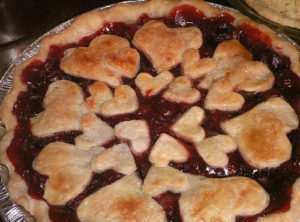
Who doesn’t like pie? Two weeks from now will be the seventh anniversary Pie Night! Come celebrate seven years of pie with… more pie!
Where? My place. 2301 Fairview Ave E Apt 107, Seattle.
When? Saturday, March 14th at 3 pm. Get it? 3-14? Hahahah… Anyway.
The schtick: I make pie. A lot of pie. Attendees are welcome to bring homemade pies, but this is not required. Anyone may attend so long as they like to eat pie. It officially starts at 3 p.m., but really folks are welcome to come by any time. Children are also welcome if you don’t mind them being exposed to whatever licentiousness may come (last time folks were comparing bras, for instance). What are not welcome are cakes, cookies, latkes, or other non-pie items. Those are fine things, but they belong on cake night, or cookie night.
I am expecting a fairly large turnout, so I am requesting that folks who plan to come please so indicate (along with the number of guests coming with them and if they plan to bring a pie). This way I know how much pie I need to make. I would not want to run out of pie prematurely. To let me know, just comment here, or add yourself to the Π Night Facebook event.
I heart pie image by Flickr user cobalt, used under a Creative Commons Attribution Non-Commercial 2.0 license.
 .

 (watch for a review over at




 .